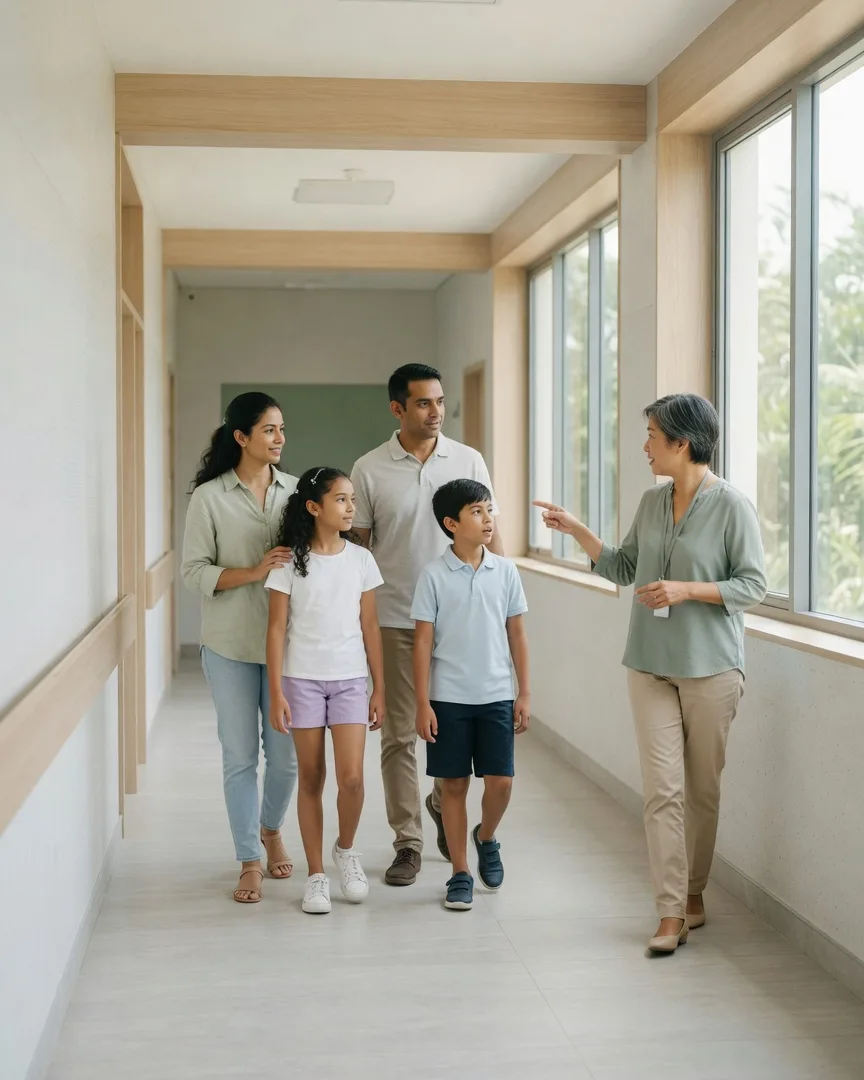
The Andersen family moved from Copenhagen in 2024. One child is in Grade 2. The other is in Grade 7. They joined Kanade International School in Lisbon and, looking back, the period they want to talk about is the first term: not a later year, and not a set of results, but the weeks in which the city, the gate and the timetable became ordinary.
They chose the school the way the admissions office still asks families to choose it. An enquiry went to admissions@kanade-school.example. A reply came within two school days. They visited, then applied with previous school reports and the application fee of €250. The assessment and the family meeting were held within ten school days of the complete application. The offer was confirmed with the enrolment deposit of €2,000, which is credited to the final term. Leila Haddad, Director of Admissions, was the person on those emails. None of that felt like campus life yet. It felt like paperwork done in the right order.
The first morning was the part they remember in pictures. Arrival is at 8:20. Parents and children walk through the gate and along the tree-lined path toward a low white building under oak trees. The address they had typed into a map was Rua do Jardim Alto 18, 1400-150 Lisboa. Seeing the path made the address a place. Grade 2 and Grade 7 split there, one toward primary, one toward the middle years, and the family waited to learn whether that split would feel like two schools or one.
It felt like one. Kanade was founded in 1994 and keeps Kindergarten through Grade 12 on a single campus. About 640 students, aged 4 to 18, come from about 40 nationalities. English is the teaching language. The Grade 2 child entered the Primary Years Programme, which Tomás Ferreira leads from Kindergarten to Grade 5. The Grade 7 child entered the Middle Years Programme, which Amara Nwosu coordinates from Grade 6 to Grade 10. They share the library, the dining hall, the music room and the field. The older student will not meet the Diploma Programme until Grades 11 and 12. For the first term it was enough that both names were called on the same site.
Language was the worry they had brought from Copenhagen. Lessons are in English. The school’s account of itself is that children learn in English, keep a home language, and leave ready for the IB Diploma. Portuguese is taught from Kindergarten, so the Grade 2 child started it at once. French or German begins in Grade 6, so the Grade 7 child met that choice in the first weeks as well. Mother-tongue clubs, overseen with the rest of the pathway by Mei-Lin Chou, Head of Languages, were the place the home language was treated as something to keep rather than to park. The family did not try to become a Portuguese household in a term. They tried to let English be the classroom, and to let home stay home.
The clock did more settling than any speech. Lessons run from 8:30 to 15:20. Break is at 10:40, often on the grass. Lunch is at 12:30. They took the lunch programme, which is optional and costs €1,280 for the school year, and the dining hall became the easiest room to picture: long tables, trays, noise that meant everyone had arrived. On activity afternoons the programme is on the timetable from 14:30, and the day ends by 16:30. By 15:30 the older child was often still outside. The younger child was more often ready to go when lessons ended. Learning those two rhythms, and not treating them as a problem to solve, was a first-term skill.
They did not take the bus in those first weeks. The bus is optional, €1,650 for the year, on four routes, with the school stop called Jardim Alto. They used the Metro and bus 728 until the walk from the stop was familiar, then decided. Absence, when it came, was a short email to office@kanade-school.example by 8:15, before the 8:20 arrival. Rafael Ortiz is the Pastoral and Wellbeing Lead, and it mattered to know a name, even on days when they needed nothing from him.
Fees became real only after the deposit. For 2026–27, Primary Years tuition for Grades 1–5 is €17,600 and Middle Years tuition for Grades 6–10 is €20,400, payable in August, January and April, or in full by 15 July for 3 percent off. Their first term was the earlier stay, in 2024, and they are careful not to mix that memory with a later price list. What they will say is that the bill and the day are different subjects. The day was the gate, the two year groups, English in the classroom, and lunch at 12:30.
Open mornings are how they now tell newer families to begin. The published Tuesdays, 9:30 to 11:00, are 10 November 2026, 12 January 2027 and 9 February 2027. A morning visit is shorter than the day their children lived through. It is still the right first look. The Andersen family stayed. Their account stops at the end of that first term, which is as far as they agreed to tell it.