Screen and Workplace Eyes
the working distance
The screen-work eye assessment is forty-five minutes and $85. It is for eyes that tire at the desk, and it measures distance, lens, and how the two eyes hold a near task.
The working distance
a measurable distance
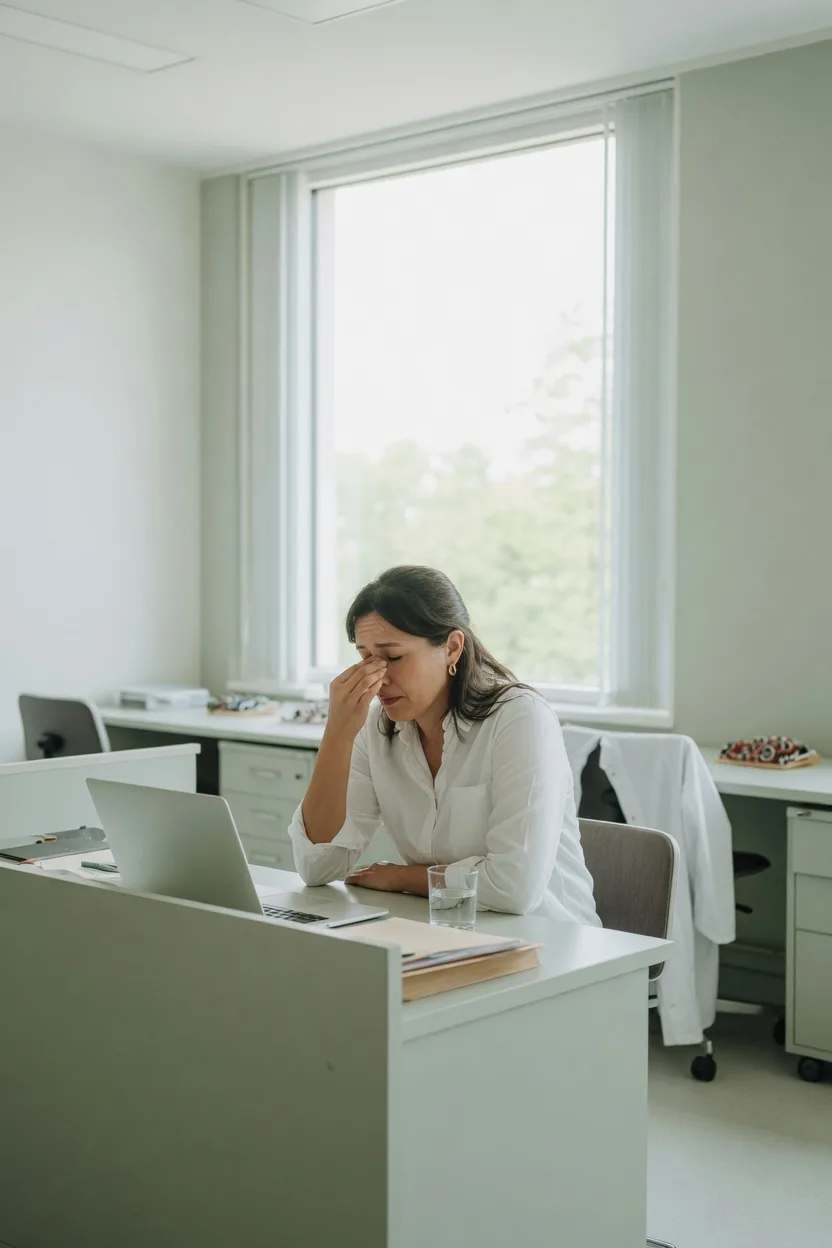
Four o’clock is a
time we can write
down.
We measure the distance from your eyes to the screen you actually use. In the account of M., an accountant of 46, the monitor sat at 55 cm. After the assessment it was moved to 65 cm. Those two figures are hers. Yours will be whatever we measure on the day. A screen held close asks for more focusing effort for more of the day, and the number goes down in the record before anyone talks about lenses.
We also ask when the symptoms arrive. Tired eyes by four o’clock, a headache that settles in mid-afternoon, blur that clears on the way home: the timing is part of the history. Dr. Jonah Whitfield leads this work. The screen-work eye assessment is forty-five minutes and $85.
Bring the glasses you use at the desk, even if you think of them as “old”. If you can, know the distance before you come. If you cannot, we will measure a comparable distance here and ask you to confirm it against your own monitor. The plan uses your number.
Monitor height and the 20-20-20 habit
monitor height and breaks
Monitor height is the other half of the desk. A screen set high leaves the lids open and the surface dries. A screen set low recruits the neck. We look at the height you use and suggest a change you can make with the stand you already have. We are here for the eyes. Neck tension is often part of the story you tell, and we listen to it as a clue to the desk, then we send musculoskeletal care to the people who provide it.
The 20-20-20 habit is a break we will talk through when it belongs in the plan. Every twenty minutes, look at something about twenty feet away, for about twenty seconds. It is a pause for focus and for blinking. It does not replace a lens the refraction has shown you need. Many people who come for this assessment have no pause in the afternoon at all. We would rather add a pause to a measured plan than offer the pause as the whole plan.
Dr. Whitfield will say whether the habit earns a place. If your symptom is blur that never clears, the phoropter comes first.
Occupational lenses
lenses for the desk
Occupational lenses are built for a range of near distances. In M.’s account the near add was +0.75, and the lenses were specified for 50–70 cm: the band between a document and a monitor. They were for that band. They were a poor choice for driving, and we said so. Her screen then moved from 55 cm to 65 cm, inside the range the lenses were made for.
That is one prescription. It is not a package handed to everyone with a laptop. Distance glasses, a separate pair for the desk, or occupational lenses are three different answers. The assessment tells us which one matches the way you work. The fee does not include the lenses. Frames start at $160, and lenses are quoted after the exam, once the prescription and the working distance are both known.
Ines Kowalczyk fits the frame and checks that the lens type on the order matches the range we wrote down. You can take the prescription away and decide later. The quote will still be in US dollars, the same in every language.

week 0, 4 pm, second coffee

week 6, same desk, new lenses
M., age 46, accountant
one account
M. is 46 and works as an accountant. She came because of headaches at four in the afternoon. Her screen sat at 55 cm. We measured a near add of +0.75 and prescribed occupational lenses for 50–70 cm. She moved the screen to 65 cm. At the six-week check she reported afternoons without headaches.
The photographs are the desk before and after. One caption reads: week 0 — 4 pm, second coffee. She is leaning toward the monitor, a slight squint, the day still in front of her. The other reads: week 6 — same desk, new lenses. Thin metal glasses, sitting upright, the same kind of work.
This is an individual account. Results differ. We cannot promise the same result. We can measure your distance, your add, and your symptoms, and we can tell you what we would change. A headache can have causes this clinic does not treat. What we report is what we measured, what we changed, and what M. said at six weeks.
The assessment fee
the assessment fee
The screen-work eye assessment is forty-five minutes and $85. It covers the history of the desk, refraction as it relates to that work, binocular vision at your working distance, and a plan. It is a focused visit. When the findings need the longer look at eye health, we say so and book the comprehensive exam, which is sixty minutes and $120.
A follow-up check within six months is twenty minutes and $40. M.’s review at six weeks was that kind of return to the record. Your review is booked for the question we actually left open.
Hours are Monday to Friday 10:00–19:00 and Saturday 9:00–16:00. Sunday and public holidays are closed. Phone +1 555 0142 208 or email hello@hitomivision.example and ask for a screen-work assessment with Dr. Jonah Whitfield. If dryness is the larger complaint, the dry eye evaluation may be the better first hour. The desk will help you choose.
Mon–Fri 10:00–19:00 · Sat 9:00–16:00 · Sun and public holidays closed