Earlier this month, a customer brought a heavy cast-iron skillet to our service counter at Harbour Street 14 in Northbay. The pan had belonged to her grandmother and had been cooked in continuously for forty years. Decades of bacon fat, pan-fried potatoes, and stovetop stews had left a thick, uneven crust of charred grease along the exterior walls, while moisture in recent storage had produced patches of orange rust across the cooking base. The cooking surface had lost its slick release, but beneath the rough black crust, the iron casting remained completely sound. This skillet was never meant for the scrap heap; it simply needed the patient intervention of our workshop bench.
At Kama Cookware, founded in 2016 by Ines Valdés, our entire practice rests on the understanding that solid cookware is made to be kept and repaired. When the skillet arrived on Tuesday morning during drop-off hours, Tomasz Wren inspected the casting to confirm there were no hairline fractures or structural flaws. Our inspection process took two days to evaluate the depth of the oxidation and measure the flat plane of the bottom. We issued our standard fixed quote of €38 for full rust removal and re-seasoning, a standard turnaround of seven to ten days.
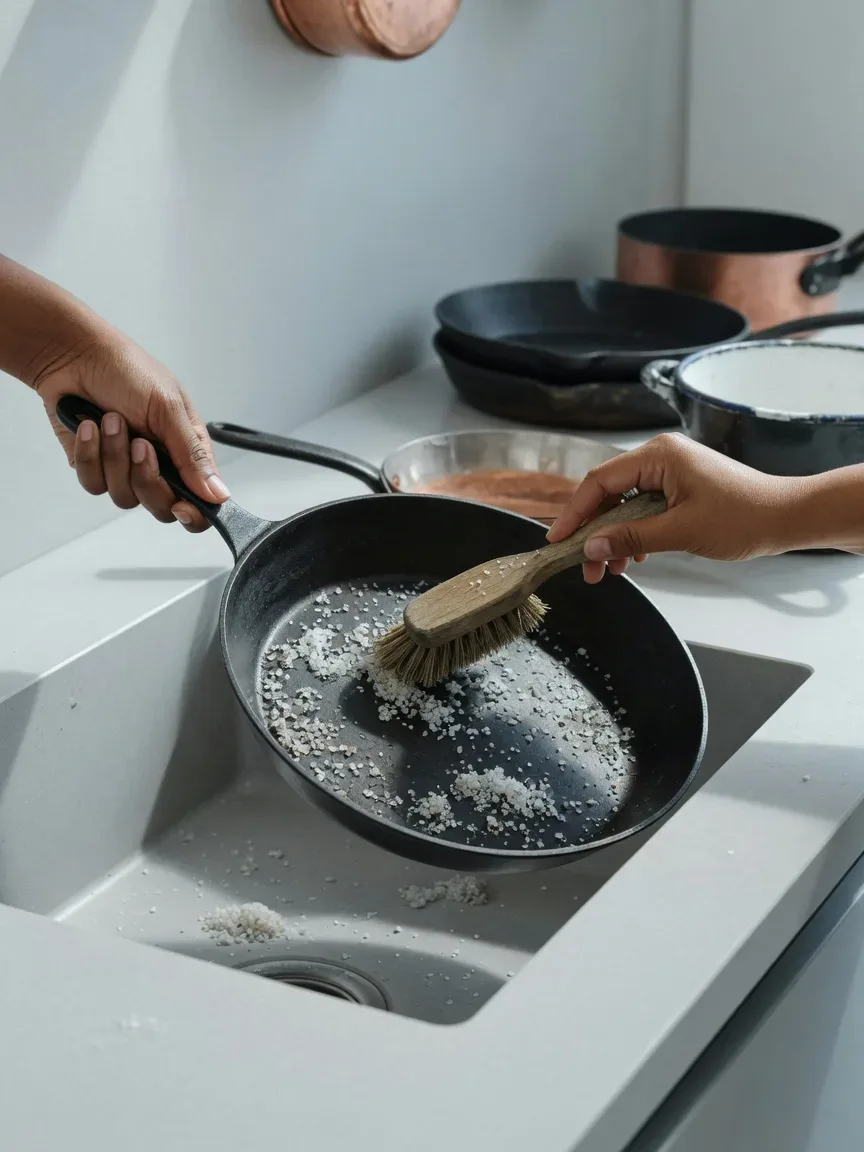
Restoration began under the supervision of Lin Hao at our seasoning station. The first stage required removing decades of carbonized buildup down to the bare, unblemished dark grey iron. Using traditional abrasive techniques with coarse salt and mechanical wire brushing at our workshop sink, Lin stripped the encrusted layers away without eroding the original metal. Once the surface was scrubbed clean and rinsed thoroughly with clear water, the skillet was immediately placed onto our high-heat burners to drive out every trace of trapped moisture before flash rust could take hold.
With the raw iron completely dry and heated to temperature, Lin began the re-seasoning process. Applying micro-thin layers of neutral cooking oil with a natural cloth, he wiped the pan down repeatedly until no wet puddles remained. Over continuous heat, the thin film of oil bonded to the microscopic pores of the iron, polymerizing into a smooth, bronze patina. Lin repeated this process three times, allowing the pan to cool slowly between coats, until the skillet developed a deep, uniform satin sheen across both the interior basin and the handle.
When the customer returned to our Harbour Street shop the following week, the forty-year-old skillet was waiting on the counter, wrapped neatly in brown paper with an updated care card. Lin explained the simple rhythm that will protect the new surface for another generation of cooking: wash under warm water without harsh detergents, heat on the hob until dry, and wipe a single drop of oil across the warm iron after every meal. Whether used on gas, induction, or inside a hot baking oven, a skillet treated this way will endure. Holding the restored pan, it was clear that with honest care, twenty years is only the beginning of what good cookware can do.