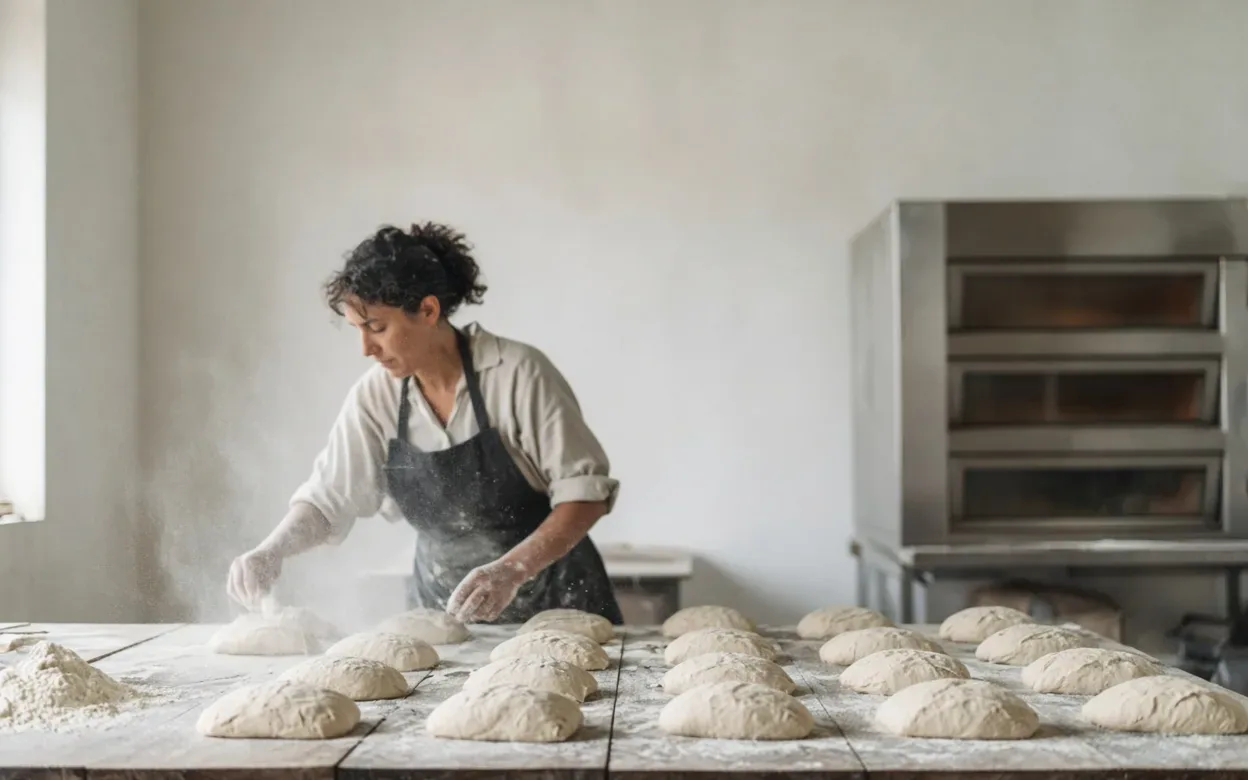
At four-thirty in the morning, Spelt Yard is entirely still. The streetlamps cast long shadows across the cobblestones, and the tram rails along the corner of number 9 remain cold. Inside the bakehouse, however, the day begins with a single switch. Lukas Brandt turns on the heating elements of our second-hand deck oven, illuminating the stone chambers with a low hum. For nearly two hours before the first loaf enters the chamber, those heavy stone decks absorb heat. You cannot rush stone; if you load bread into a deck oven that has merely reached surface temperature, the stones lose their heat the moment cold bannetons touch them. Lighting the hearth at 04:30 is our commitment to crust, crumb, and oven spring.
While the stone warms, Lukas moves to the wooden mixing trough to begin the autolyse. We work exclusively with stoneground flours sourced from our regional milling partners. The wheat comes from Molen Ter Beke, just twenty-two kilometres away, while our dark rye arrives from Lindenhof mill, thirty-eight kilometres across the countryside. Lukas blends the stoneground flour with cool well-tempered water, leaving the mixture to rest in silence. This pause allows the grains to hydrate fully and enzymatic activity to begin naturally, long before salt or starter are introduced.
By 05:30, Ama Owusu arrives at the bench. The autolysed dough has developed strength and elasticity without aggressive mechanical mixing. Ama folds in the levain—our solitary mother culture that Tomasz Wierzbicki and Ines Moreau have fed and nurtured every single day since we opened in 2019. The room begins to smell gently of sour apple and lactic fermentation. Working with deliberate, steady movements, Ama divides the dough into 900-gram portions for our Country Sourdough, dusting the timber benches with fine rye flour before tucking each piece into wicker bannetons.
At 06:15, Ines Moreau takes her position at the oven mouth. The deck temperature has stabilized completely, holding deep radiant heat within its refractory hearth. Ines tests the dough with a fingertip, checking the gentle resistance of the ferment. With three decisive cuts of a curved razor across the proofed loaves, she transfers them to the long wooden peel and slides them smoothly onto the glowing stone floor of the deck oven. She injects steam into the sealed chamber, locking in moisture so the dough can expand freely without setting its crust prematurely. Through the thick glass door, the loaves rise dramatically, blooming along the scored ears.
Meanwhile, the subsequent bakes are already being staged. Dark rye dough, dense with whole grain from Lindenhof mill, rests in linen-lined tubs while Mei Chen prepares the buttered trays for Saturday’s cardamom knot buns. Each loaf follows an unhurried sequence determined by stone deck temperatures and oven availability. Because we rely on a single oven rather than an industrial conveyor, timing is precise: bread cannot wait for the oven, and the oven cannot wait for the bread. Every morning depends on this seamless coordination between mixer, shaper, and hearth.
By seven o’clock, the transformation is complete. Priya Raman unlocks the front entrance, turning the door sign as the scent of dark caramelised wheat drifts out into Spelt Yard. The first batch of Country Sourdough rests on tall wooden cooling racks by the window, crackling softly as ambient morning air cools the crusts. The street outside begins to stir with cyclists, school children, and neighbours stopping by before work. Behind the counter, Priya stacks the day’s first loaves, ready for the neighbourhood that built us. That quiet ritual at four-thirty made this bread possible.