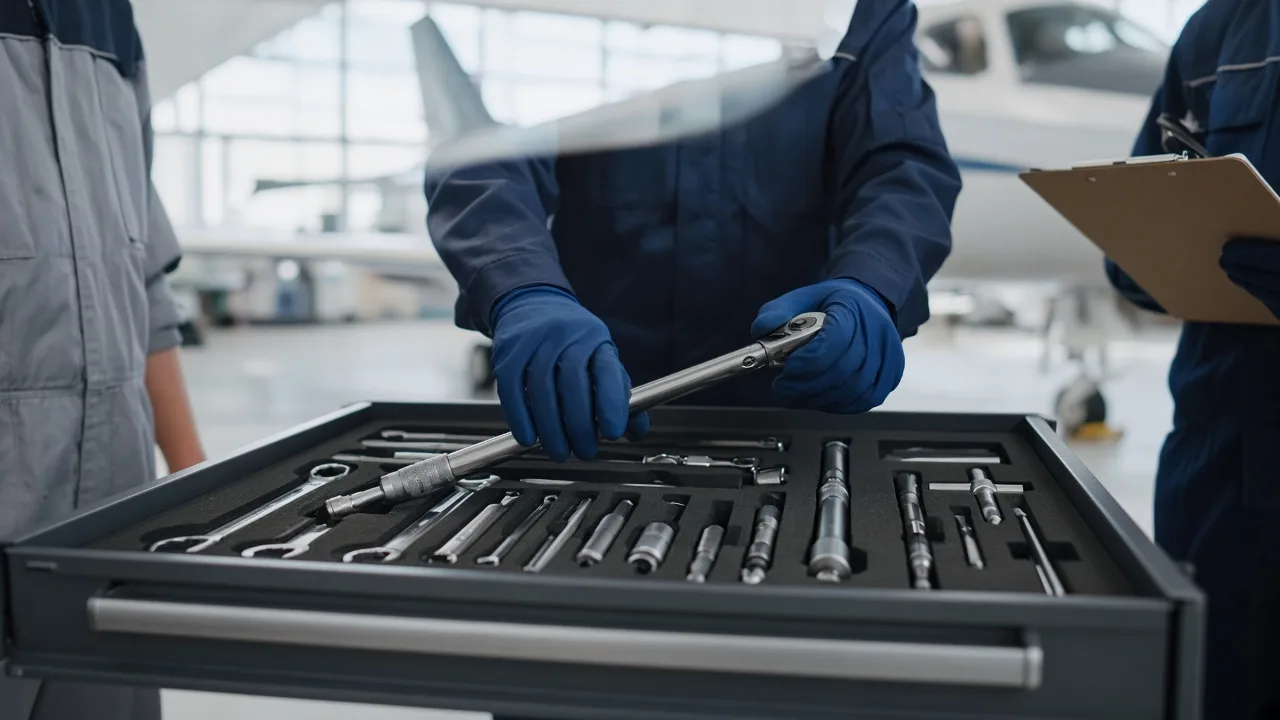
At 15:00 on any weekday at Tsubasa College, the atmosphere in Hangar 1 and Hangar 2 shifts from the steady clatter of pneumatic tools to deliberate, quiet concentration. The scheduled work on the airframes has concluded for the day, but the maintenance cycle is far from complete. This final working hour before the hangar doors close at 16:00 is reserved for duplicate inspections, maintenance logbook entries, and strict tool control. For students enrolled in our eighteen-month licence-track programme, this afternoon ritual is where technical knowledge transforms into licensed responsibility.
A duplicate inspection is mandatory whenever work disturbs vital aircraft systems whose failure would jeopardize safe flight, including flight control cable runs, engine throttle linkages, and critical locking hardware. The regulatory requirement is deceptively simple: after the technician who performed the task completes and inspects the assembly, an independent, authorized person must conduct a completely separate inspection of the work. Neither person assumes the other was thorough; both inspect every split pin, castellated nut, safety wire twist, and turnbuckle as if their own certification alone confirmed airworthiness.
Under the guidance of Pieter de Vries, who leads our human factors and civil aviation regulation modules, students quickly learn that duplicate inspections are psychological exercises as much as mechanical checks. Confirmation bias is a persistent human vulnerability. When a technician has spent three hours assembling a torque tube or tensioning an aileron control cable, their brain naturally expects every fastener to be secure. The independent inspector must approach the identical mechanism with deliberate detachment, asking not whether the work looks acceptable, but what subtle error might have been overlooked.
In the training hangar, an instructor like Daniel Okafor or Tomás Rivera steps in as the countersigning inspector only after the student has conducted their own preliminary check. Holding a blank checklist card, the instructor watches the student explain the procedure step by step. Which maintenance manual revision governed the task? What torque setting was specified, and which calibrated wrench was checked out from the tool store? Did the cable tension correspond with the ambient hangar temperature chart? The student must physically verify every lockwire and cotter pin in the presence of the countersigner.
This discipline reinforces the founding principle established by Henrik Aalto when Tsubasa College first opened its doors in 1998: we teach on real aircraft, and every task is signed and countersigned. There is no partial credit in maintenance record-keeping. If a task card is signed before the work is verified, or if a duplicate inspection is treated as a perfunctory formality, the exercise is halted immediately for a thorough case debrief.
When the second signature is applied to the task card, it signifies more than technical compliance. It represents mutual trust between two professionals who have examined the same mechanical assembly from independent perspectives. As toolboxes are locked and shadow boards counted down to the last socket at 16:00, students understand that a duplicate inspection does not signify lack of confidence. Instead, it is the highest expression of professional humility and the foundational safeguard of civil aviation safety.