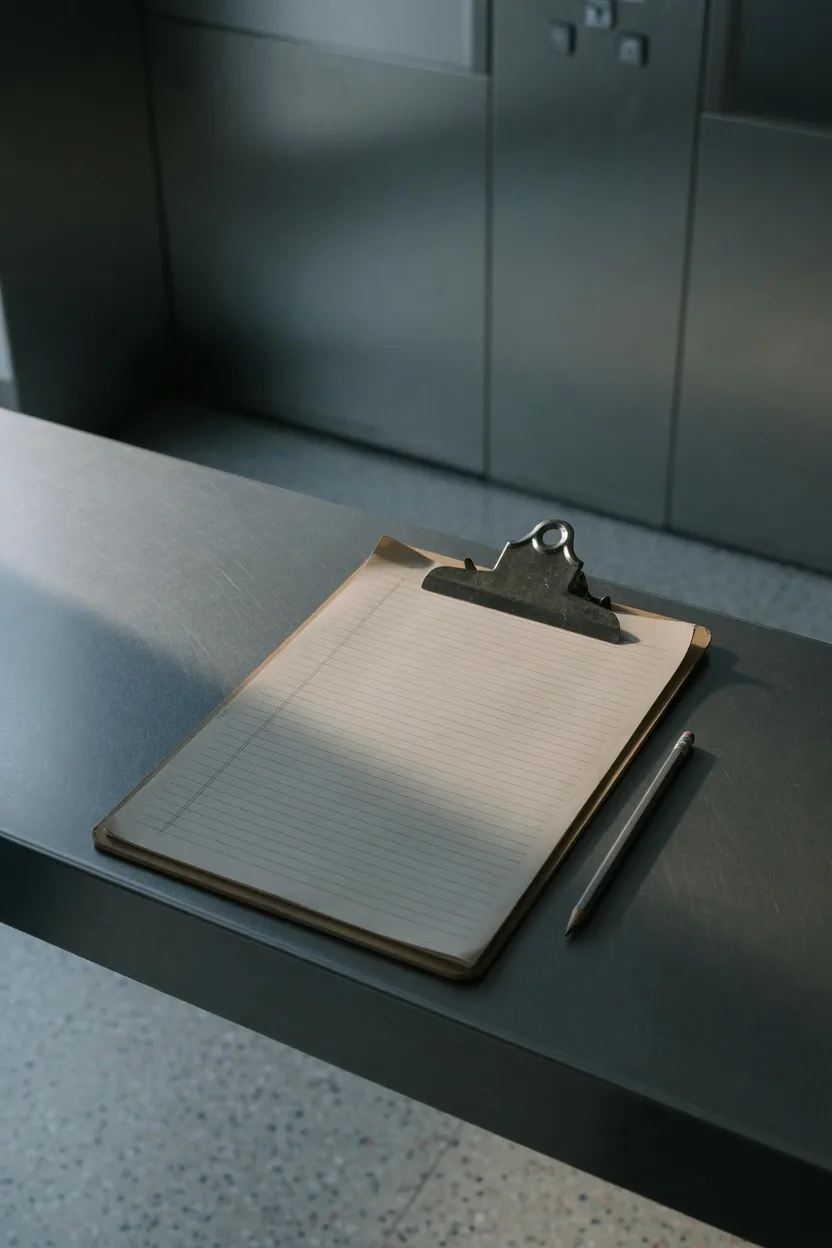
The inspection hour carries a paper checklist of thirty-two points. Two technicians mark it between minute ten and minute fifty, after the lift has been taken out of service and before it is returned. The points are grouped, and the groups always add up the same way: landing doors six, car five, car doors four, pit four, rails and guides three, machine four, controller four, lobby and signs two. The list is included in the hour. So is the written report that follows within two working days. Samira Haddad writes that report from the sheets. She does not invent a second list back at Wharf Row.
Landing doors are the first group, six points, and they are where a hesitation often shows. At Alder House, nine floors and two lifts, the manager Priya Nair had a door that hesitated on floor 6. The hour traced that hesitation to a worn sill guide. The finding went onto the paper at the landing, with the other door points beside it. It was still on the sheet at minute fifty, when we read the pages with Priya and then put the lift back into service. We did not change the guide during the inspection. The sheet named the part. The report, sent within two working days, named it again.
The car is five points and the car doors are four more. We keep them as separate groups because a door fault and a car fault are different work afterwards. Car doors sit with Kofi Mensah, the senior technician for doors. If a door later needs adjustment, that is its own visit at $320. It is not done inside the inspection hour, and it is not hidden inside the $240. At Alder House the worn sill guide stayed a landing-door finding. The hour recorded it. The adjustment, if Priya books one, is another morning.
The pit is four points. Rails and guides are three. Marek Lindqvist is the technician for pits and rails, and this part of the hour is his: buffers, guides, and the rails the car runs on, seen with a work light. The marks go on the same paper as the doors. A manager who never goes down to the pit still sees those lines at the desk in the last ten minutes. That is the reason the checklist is paper. The list has to be in the room with the person who will read it at minute fifty.
The machine is four points and the controller is four. Arjun Menon takes machine rooms. Naledi Dube takes controllers. The machine stop is the traction machine and the cabinet, looked at with the door open and left closed again before we go. Controller points sit next to machine points on the sheet, so a later quote can be read against a group. A written second opinion on someone else’s quote is a different booking, at $180. The inspection list is only what these two technicians saw on the day, in that room, during that hour.
Lobby and signs are the last two points. They cover the landing as a person waiting would meet it, including the notice we stood there when we took the lift out of service. The notice comes down when the lift returns. The two points remain on the sheet. They are easy to treat as small, and we keep them, because the lobby is one of the five stops. Landing, car, pit, machine, lobby. Skip the last and the thirty-two are no longer complete.
When the papers are thin, the checklist is the whole record. Foundry Court is six floors and one lift, a converted warehouse, managed by Daniel Osei. The lift had no paperwork. The thirty-two points from that single hour became its first written record. Daniel heard them in the last ten minutes. Samira wrote them up within two working days. Where a building already has a file, the new sheets join it. We do not score the old file against the new one, and we do not publish a comparison.
The hour is not a statutory examination. The report does not certify the lift. A clear sheet is an account of one quiet hour, two technicians and thirty-two marks, not a promise about the weeks after we leave. The first lift is $240. Each further lift on the same visit is $140 and receives the same list, in its own sixty minutes. At Meridian Yard, Lucia Ferrante used three such hours across two mornings so twelve floors and three lifts could be checked with one car left free for early staff. That is what the paper catches. A named part, a full group count, and a page the manager has already seen before we leave the lobby.