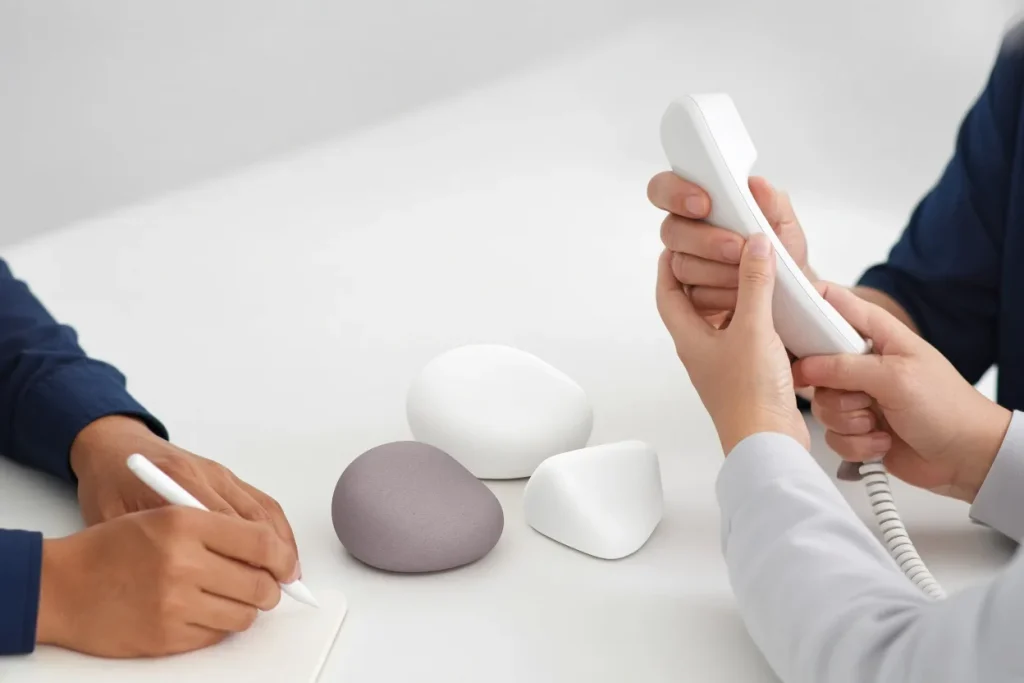
Before · the hand-sanded model
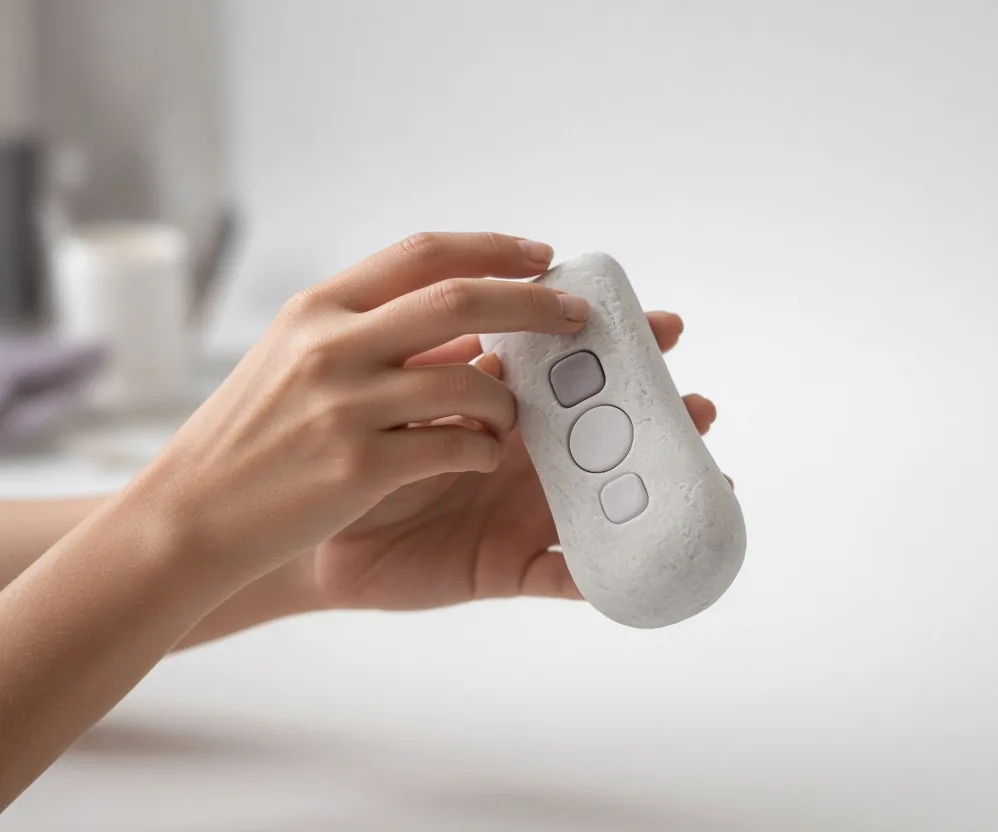
One of the foam handsets, turned in the hand during a review.
After · production part
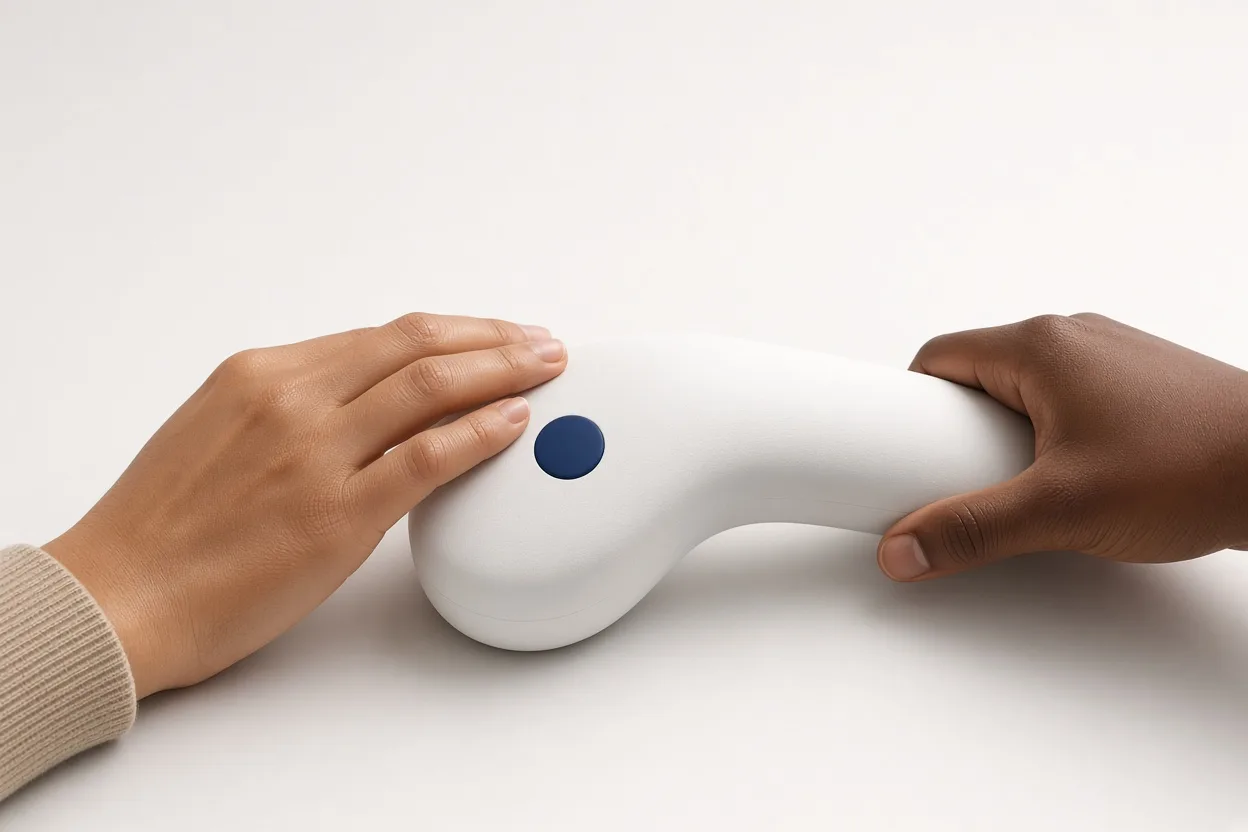
The finished handset with a navy button you can find in the dark.
In a busy hospital ward at three in the morning, ambient lighting is kept to a minimum so patients can rest. For a registered nurse responding to an urgent monitor chime or a whispered request from a darkened room, every second matters. Yet when a regional hospital equipment maker approached our Haverholt studio in 2024, they brought a frustrating paradox: their newest bedside nurse-call handset had passed every digital human-factors simulation, yet clinical staff and resting patients found it nearly impossible to use in real life. Night nurses could not locate the primary call button by touch in the dark, and elderly patients with reduced dexterity regularly dropped the slick plastic enclosure off the edge of their beds.
The failure did not stem from electronic circuitry or communication protocols; it lived entirely in the tactile geometry of the enclosure. Digital CAD models on screen can illustrate clearance envelopes and wall thicknesses, but they cannot tell you what a nurse’s thumb feels when reaching blindly toward a bed rail at midnight. To understand the reality of the problem, our design researcher Lena Brandt spent several night shifts inside active hospital wards, observing staff interactions under subdued lighting. She watched nurses repeatedly fumbling across flat surface housings to find actuation buttons and noted how loose cords snagged against blankets, pulling handsets onto linoleum floors.
Back inside Studio 4 at Foundry Lane, head of model shop Kofi Asante and design director Ines Varga began carving answers directly in high-density polyurethane foam. Over the course of fourteen months from initial brief to the delivery of the first production tool sample in March 2025, our workshop produced forty-one distinct, hand-sanded foam prototypes. Each model represented a subtle adjustment in grip circumference, thumb recess depth, and perimeter weighting. We took these physical models back to clinic staff on Tuesdays, asking nurses to locate the primary button with their eyes closed while wearing disposable nitrile gloves.
Through continuous physical iteration, two critical architectural innovations emerged. First, rather than centering the call trigger within a flat cluster, we carved an asymmetrical, scoop-shaped thumb depression that naturally guides the user’s thumb directly onto an oversized tactile button. Industrial designer Amara Okafor translated these physical ergonomic coordinates into usability files for the client’s regulatory submission. Second, to prevent handsets from crashing onto the floor, we molded a gentle reverse-curve hook into the upper chassis, allowing the handset to drape securely over standard hospital bed rails without slipping.
Once the physical form was validated through foam model 41, mechanical engineer Mateo Ruiz engineered the production assembly for tooling. Mateo analysed structural wall thicknesses, draft angles, and internal screw bosses to ensure that the two-piece enclosure could withstand daily cleaning. Sofia Lindqvist finalized the CMF specifications, pairing a matte white enclosure with a soft navy primary call button that provides immediate visual contrast in daytime and unmistakable tactile feedback at night. When our team stood beside the injection molding machines to review the first-off samples, the molded parts snapped together cleanly without adhesive or rework. The forty-one foam handsets on our workshop bench had resolved every question before the first steel tool was cut.