Who comes in after 18:00, and why?
Conducted across five municipal library branches in 2023, this study analyzed evening patron activity to understand community space usage. Our findings provided empirical qualitative evidence regarding municipal facility requirements after standard business hours.
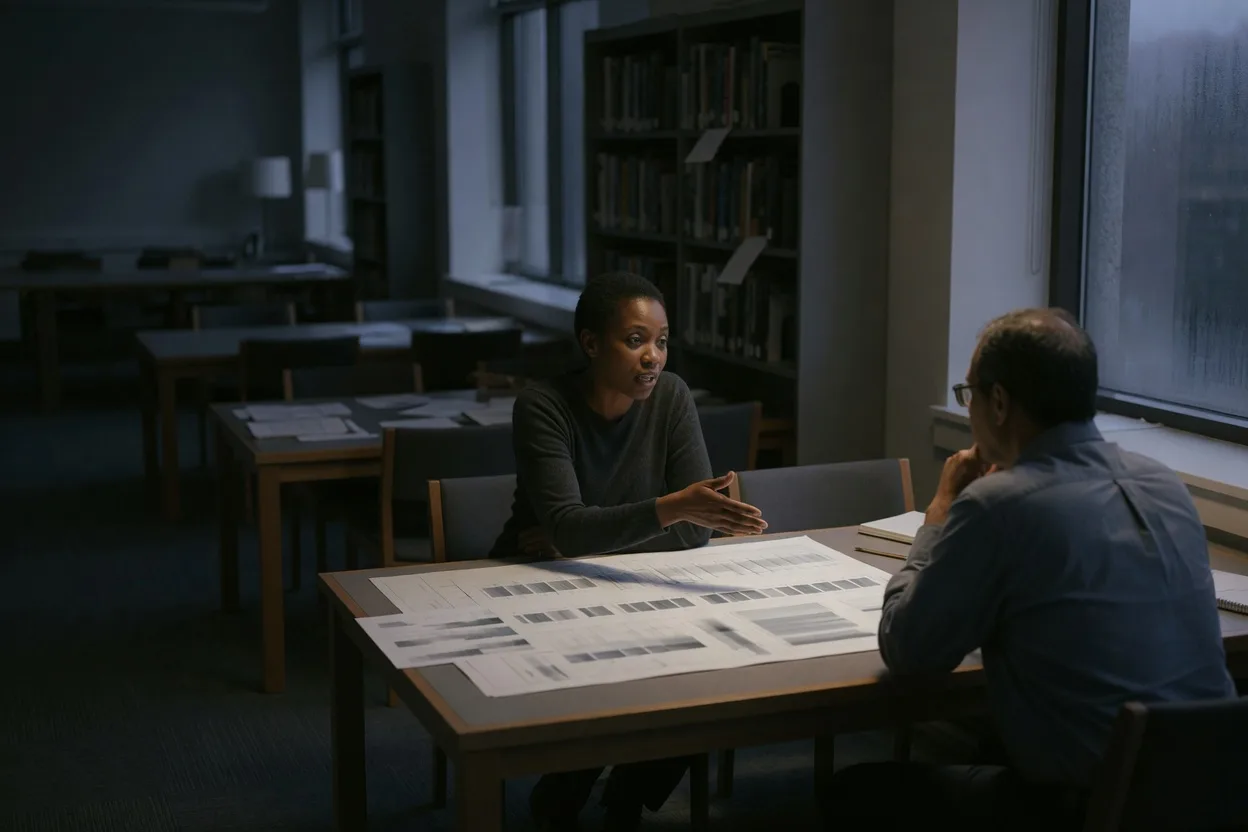
Library network, 2023
IN NUMBERS
01 — Library network, 2023
interviews
32
branches
5
findings
4
THE BRIEF
02 — The question and how we worked on it
The Municipal Question and Study Setup
Municipal library administrators faced budgetary pressure regarding operating hours and sought qualitative clarity on evening operations: ‘Who comes in after 18:00, and why?’ Rather than relying on simple automated turnstile counts, Shirabe Research was engaged to investigate the motivations of evening visitors. Fieldwork was conducted across five distinct municipal branches. Senior moderator Nadia Haddad and fieldwork lead Tomás Ibarra spent three weeks on site, conducting thirty-two semi-structured interviews with patrons present between 18:00 and closing time. Researchers noted desk occupancy, lighting preferences, equipment usage, and the spatial distribution of individuals throughout each facility.
VOICES
03 — In their words (participants anonymised)
Patron Evidence and Findings
The investigation encompassed thirty-two interviews across five branches, synthesizing four foundational findings. The research revealed that post-18:00 attendance was driven by individuals seeking stable physical work environments rather than book borrowing. Patrons shared candid testimonies regarding their evening visits:
“My flat is cramped and noisy in the evening; this desk by the window is the only quiet space I have to read.”
Participant, Library network, 2023
“I do not borrow novels after six; I come to use the reference directories and desk power outlets.”
Participant, Library network, 2023
“The lighting upstairs feels safe and warm in winter, whereas the street outside is completely dark.”
Participant, Library network, 2023
These statements confirmed that the library functioned primarily as urban shelter and quiet study infrastructure.
AFTERWARDS
04 — What the client changed
What the Client Changed
Armed with the four synthesized findings, library administrators restructured their evening staffing and floor configurations across all five branches. Security personnel and library assistants were reassigned to monitor upper-floor study galleries, keeping quiet second-floor reading desks open until 20:00. Branch teams reorganized furniture layouts to position heavy study tables adjacent to wall power outlets and improved window desk illumination. Physical directory shelves and local gazette archives were relocated from locked storage to open ground-floor study carrels, directly accommodating evening researchers and independent workers who utilized municipal facilities after standard commercial business hours.