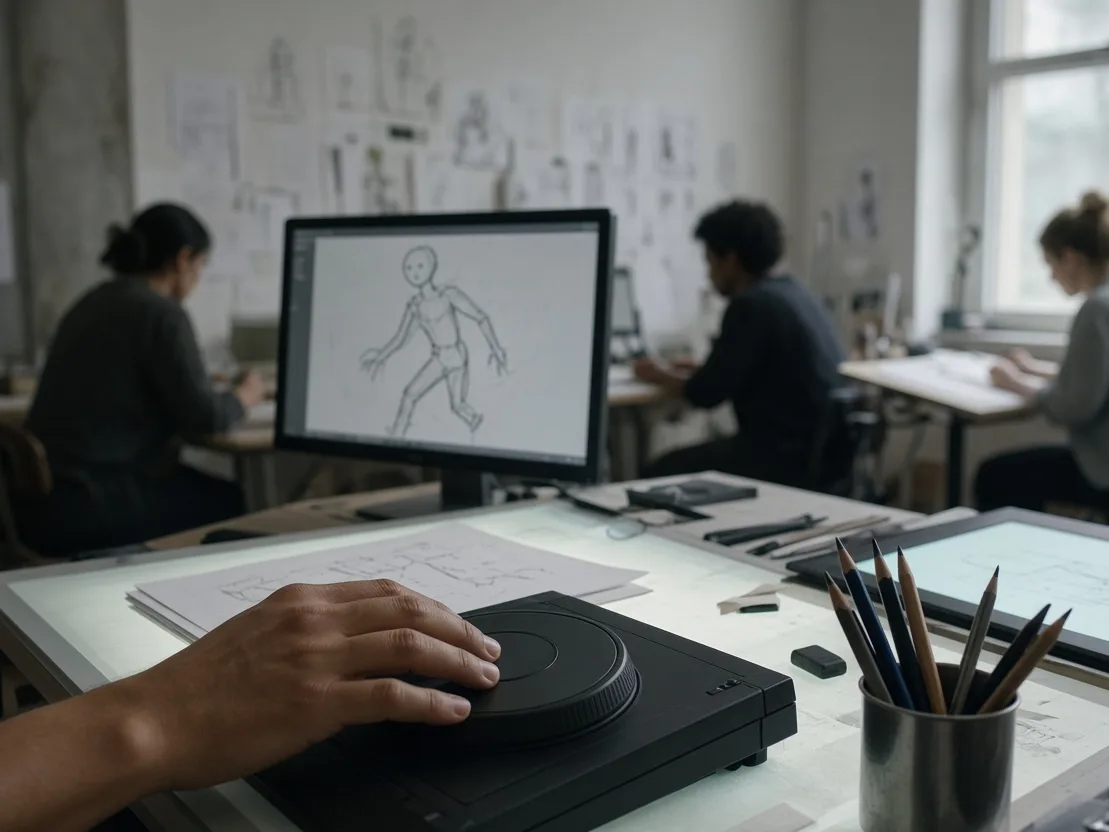
In hand-drawn animation, the pencil line test is the single most revealing milestone of a production. Before digital ink, flat color, multi-plane lighting, and sound effects are assembled, an animator’s drawings exist only as graphite on punched paper sheets held by a metal peg bar. When those sheets are captured and looped sequentially at twenty-four frames per second, the raw architecture of movement becomes visible. For agency producers and commercial directors, the line test provides immediate, unvarnished proof of whether an idea holds weight, momentum, and expressive life.
At Ugoki Animation, our eight-person studio at Canal Yard in Port Arden gathers every weekday at 14:00 around our central screening display. This daily line-test review is an essential discipline. Animators Adaeze Nwosu and Lukas Brandt bring their morning drawings directly from their glowing light tables to check how frame intervals translate in motion. On paper, flipping five sheets between thumb and forefinger gives a tactile impression of arcs and easing, but playing thirty or sixty frames back on screen reveals subtle imbalances in volume and acceleration that paper flipping can conceal.
For clients commissioning a thirty-second commercial or an opening title sequence, reviewing a pencil line test can feel startling at first. Accustomed to polished three-dimensional renders or glossy live-action rushes, agency teams are presented with rough, energetic pencil marks, construction circles, and visible peg holes. Yet this stage offers the greatest creative clarity. Without the distraction of color palettes or background rendering, directors Ines Marlow and Tomasz Reyes can evaluate character acting, posture changes, and silhouette reads with total precision. If a movement feels sluggish or a secondary action distracts from the core narrative, the pencil line test exposes the issue immediately.
This clarity is why our commercial production pipeline places the line test at the exact midpoint of our eight-week schedule. During weeks three and four, key drawings are established and tested before hundreds of intermediate sheets proceed to clean-up, digital coloring by Priya Raman, and compositing by Jonah Feld. In our standard agreements, the line test marks the second formal round of client review following the initial storyboard animatic. Making timing and choreography revisions at this stage is fast and clean; adjusting drawings on paper involves erasing graphite, whereas making revisions after digital coloring and compositing requires costly structural rebuilding.
The value of this stage is so pronounced that we frequently deliver line tests as standalone commissions. For agency teams preparing pitch presentations or validating concepts before full production funding is secured, our ten-second line test pass (€1,200) allows creative directors to test how hand-drawn motion performs in real time. Seeing genuine physical drawing moving at full speed reassures commissioners far more effectively than static concept frames or verbal descriptions.
Ultimately, the line test is a covenant between animator and audience. It proves that character emotion and narrative weight derive not from computational polish, but from twenty-four calculated drawings for every second of screen time. When a client approves a pencil line test at our Port Arden studio, they are not simply approving an unfinished sketch; they are approving the physical heartbeat of the finished film.