The diploma, part by part
Six parts across two full-time years, with ward shifts every week and 40 weeks on placement.
Six parts
two years, full-time
The Diploma in Veterinary Nursing is two years full-time, with 24 places on each of the February and September intakes. Five parts are taught here, on the ward and in the rooms beside it; the sixth, placement, takes you into partner clinics. Each part below says how many hours you spend on it.
Foundations
Animal care & handling
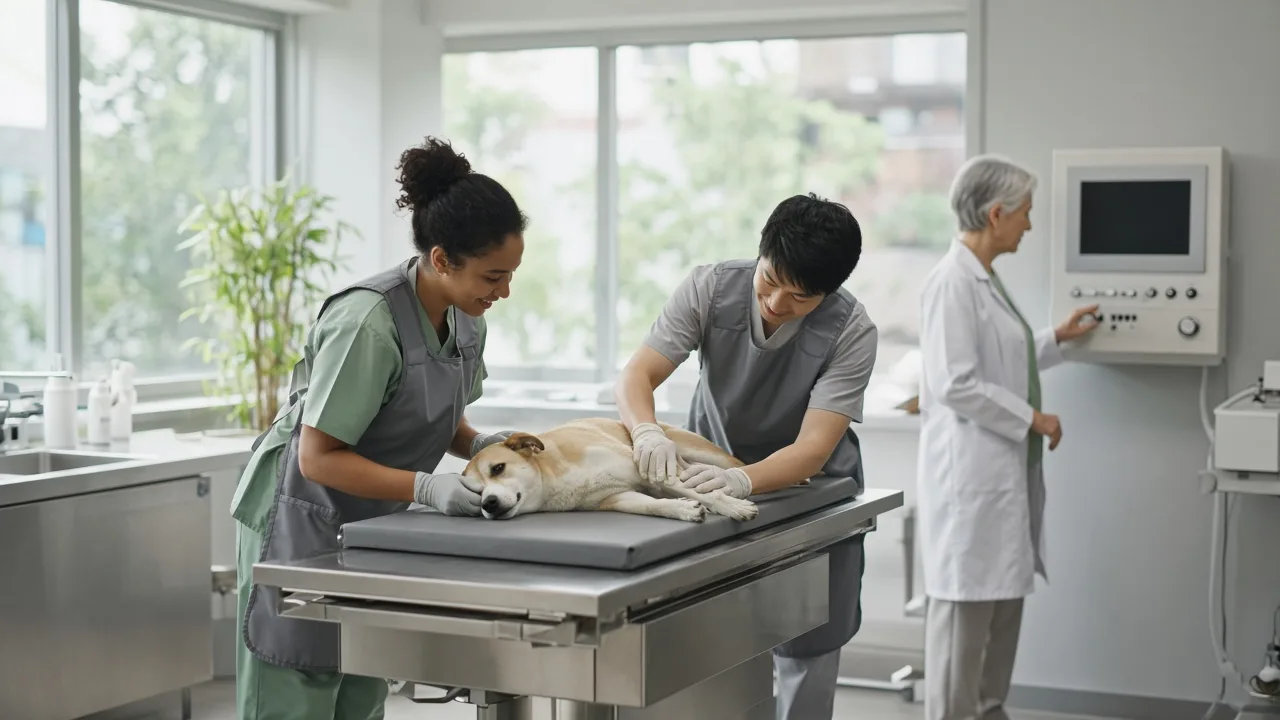
Foundations starts the diploma with animal care, anatomy and the low-stress handling that every other module relies on. You learn to restrain a dog or a cat safely, read body language, clean and prepare a kennel, and record what you see. Most of it is practical and happens in the skills room, on models first and on calm animals once your tutor is sure of your hands.
The module also covers hygiene, animal welfare in plain language and the basics of anatomy and physiology. Lectures are short and tied to what you did that morning, so a pulse felt at the wrist of a model has a diagram you drew an hour earlier.
Taught hours
260
Ward nursing
Inpatient care
Ward nursing is the longest taught module and the one you live in. On shifts from 07:45 you take observations, give feeds and medication under a vet's direction, change dressings and keep the notes for your group of six. Patients are calm, stable inpatients or post-operative cases referred by partner clinics.
You learn to notice small changes: a dog that has stopped eating, a cat that is hiding at the back of the kennel. Each round ends with a short review at the ward desk, so that what you saw becomes a note the next shift can use.
Taught hours
420
Theatre assist
Anaesthesia & surgery
In theatre assist you work in the prep room and beside the anaesthesia monitor. You prepare instruments and the patient, learn what each monitor reading means, and help the vet and the anaesthetic nurse keep the patient safe from induction to recovery.
You do not operate. Your job is to prepare, observe, record and speak up. Lucía Ferraz teaches the module, and you practise each sequence on models before you do it beside a real patient, with a tutor at your shoulder.
Taught hours
300
Imaging & lab
X-ray · samples
Imaging and lab covers X-ray positioning, radiation safety and the routine tests a clinic runs on samples. You learn to position a calm patient for a clear image with as few repeats as possible, to wear lead and keep your distance, and to prepare and label samples for the lab.
In the lab you prepare slides, read simple results and record them. Ji-woo Han teaches the module in the college's X-ray room and small laboratory, so you handle the equipment yourself and do not only watch someone else do it.
Taught hours
200
Pharmacy
Dispensing & doses
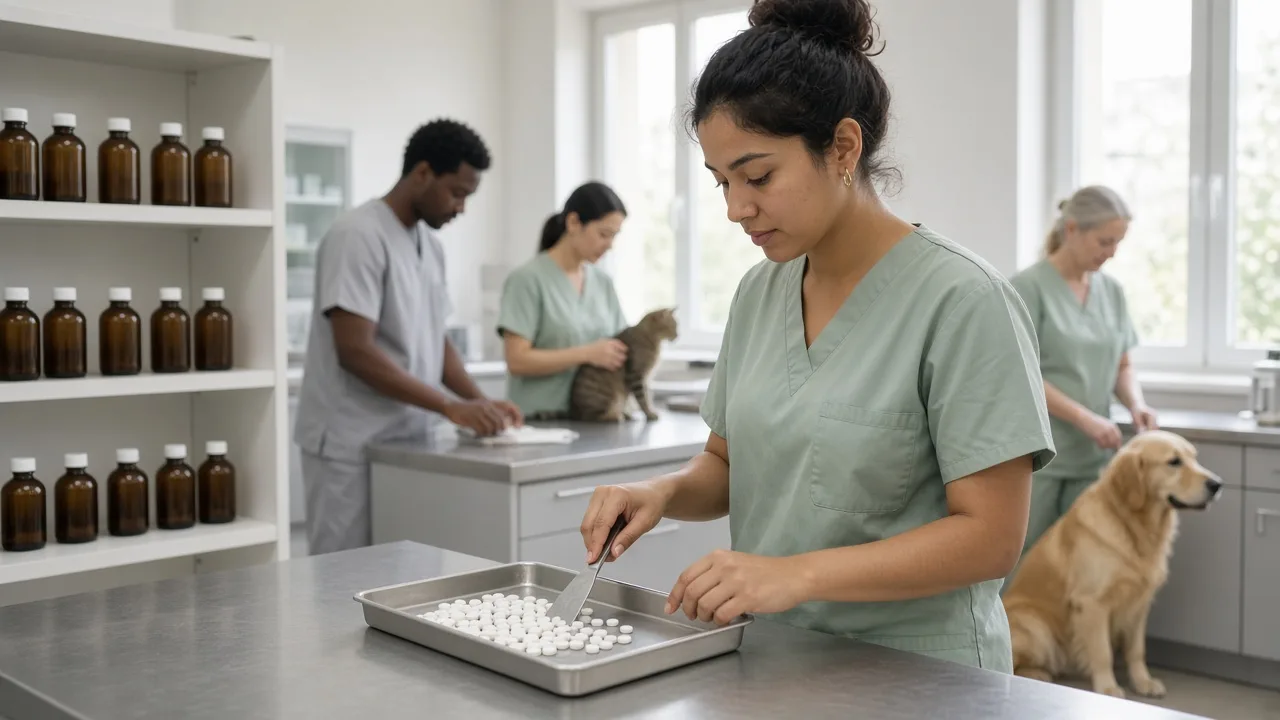
Pharmacy teaches you to dispense safely: reading a prescription, calculating a dose from a patient's weight, counting and labelling, and recording what left the cabinet. You practise on a counting tray and with dose exercises until the arithmetic is routine.
You also learn to explain a medicine to an owner in plain words, and what to do when something does not look right. Tomasz Wierzbicki leads the module. A second person always checks a dose, and you learn to ask for that check as well as to give it.
Taught hours
140
Placement
40 weeks in clinics
Placement is 40 weeks in 22 partner clinics and animal hospitals, spread across the two years. Each clinic takes 1 or 2 students in a block. Aisha Rahman matches you to a clinic, visits during the block and meets you and your clinic supervisor afterwards.
On placement you do the work of a student nurse under a vet's direction: admissions, observations, nursing care and conversations with owners. You keep a log and bring it back to college, where your tutor uses it to plan the practice you still need.
Weeks on placement
40
Alongside the diploma
part-time and evenings
Two shorter courses run beside the diploma. The evening course is for people who already work in a clinic. The foundation certificate is a first step for anyone who wants to try the work before committing to two years.
Evening course for clinic staff
Twelve evenings, Tuesdays 18:30–21:00, for receptionists, animal care assistants and anyone who works in a clinic and wants the nursing basics: handling, observations, medication safety and record keeping. It can stand alone, and some staff go on to the two-year diploma.
12 evenings · Tuesdays 18:30–21:00 · €780
Who it suitsFoundation certificate
A ten-week part-time course on Mondays and Thursdays. You learn the handling and ward routines that the diploma starts with, spend time on the ward, and find out whether the work suits you. Some students then join the diploma; others stop here.
10 weeks · Mondays and Thursdays, part-time · €1,150
Who it suitsWhere to next
for applicants
Applications for February 2027 close on Friday 8 January.