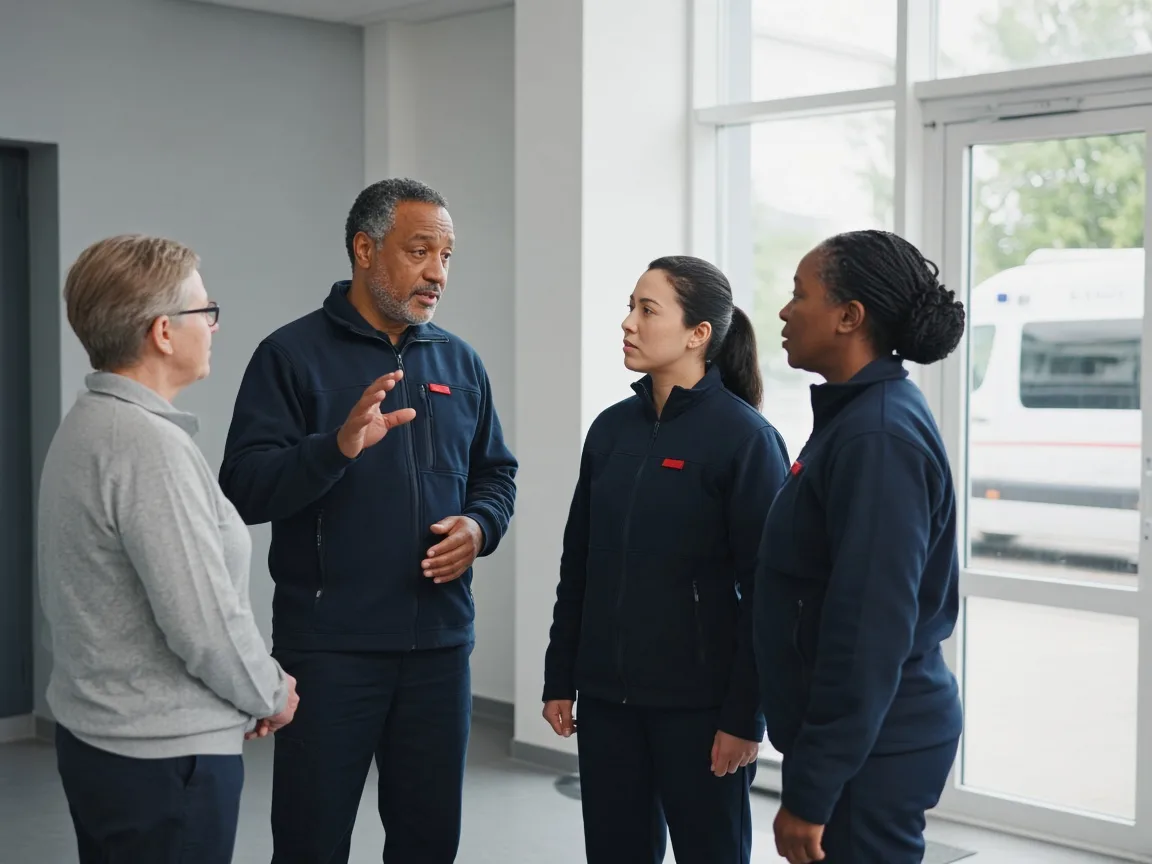
In the skills lab at Kyukyu College, a student kneels over an adult training manikin on a firm rubber floor mat. Beside him, an instructor holds a mechanical stopwatch, keeping count while a second student watches a small green diode on the manikin’s chest. The light flashes only when the compression reaches a depth of five centimetres and permits complete chest recoil at a tempo between one hundred and one hundred and twenty beats per minute. If the student slows or leans on the sternum, the diode goes dark, and the instructor’s stopwatch clicks. We reset the clock, adjust the student’s shoulder alignment, and start the cycle again. To a visitor touring our campus at 41 Wexford Lane, the repetition can appear relentless, but in emergency pre-hospital care, mechanical precision is the difference between organ perfusion and neurological death.
When our college was founded in 2011 by Dr. Ruth Adeyemi-Holm and two veteran paramedics, we committed to a scenario-first philosophy. In traditional lectures, students study the physiology of cardiac arrest from diagrams and pharmacology textbooks long before they ever place their palms against a sternum. That model fails to prepare people for the sensory reality of emergency medicine. In an ambulance bay or a crowded residential hallway, you do not have leisure to consult reference charts. The heart has stopped, cerebral blood flow is dropping by the second, and your hands must deliver steady, rhythmic pressure while sirens wail and family members watch. By introducing drills on day one, we teach students to master the physical mechanics before layering in the advanced pharmacology and telemetry analysis that follow.
Precision during chest compressions demands discipline that only controlled simulation can build. Under high stress, human beings naturally accelerate their movements or tire prematurely, resulting in shallow compressions that fail to generate adequate coronary perfusion pressure. In our skills lab, where we maintain an instructor-to-student ratio of one to eight across cohorts of twenty-four, every student receives immediate, granular correction. Our instructors are not retired academics lecturing on historical protocols; every one of us continues to work operational shifts on active ambulance crews. When I tell a student that allowing full chest recoil is non-negotiable, I am speaking from eighteen years on the road, where proper technique sustained a pulse until we transferred the patient to an emergency department team.
Over the thirty-six weeks of their first academic year, our students spend countless hours in our skills lab and inside our two ambulance-body simulators. They learn to perform effective compressions while kneeling on metal floor plates, maneuvering stretchers around narrow corners, and communicating clear patient updates over radio channels. By the time they begin their 480 required hours of ride-along shifts alongside station paramedics, this physical rhythm has become second nature. They do not have to guess whether their compressions are deep enough or fast enough; their muscle memory and clinical focus take over automatically.
Emergency medicine is often romanticized as dramatic improvisation, but its true foundation is quiet, rigorous discipline in the first eight minutes. At Kyukyu College, we measure every compression, every breath, and every pause because the patients our graduates will meet in Northmere and beyond deserve nothing less. When you step onto an emergency ambulance, you carry a community’s trust in your hands. We time every compression in the classroom so that on a dark roadside or in an unfamiliar kitchen, our graduates never falter.