We evaluate our training by the durability, precision, and neatness of the installations our apprentices leave behind on active customer sites.
(01)
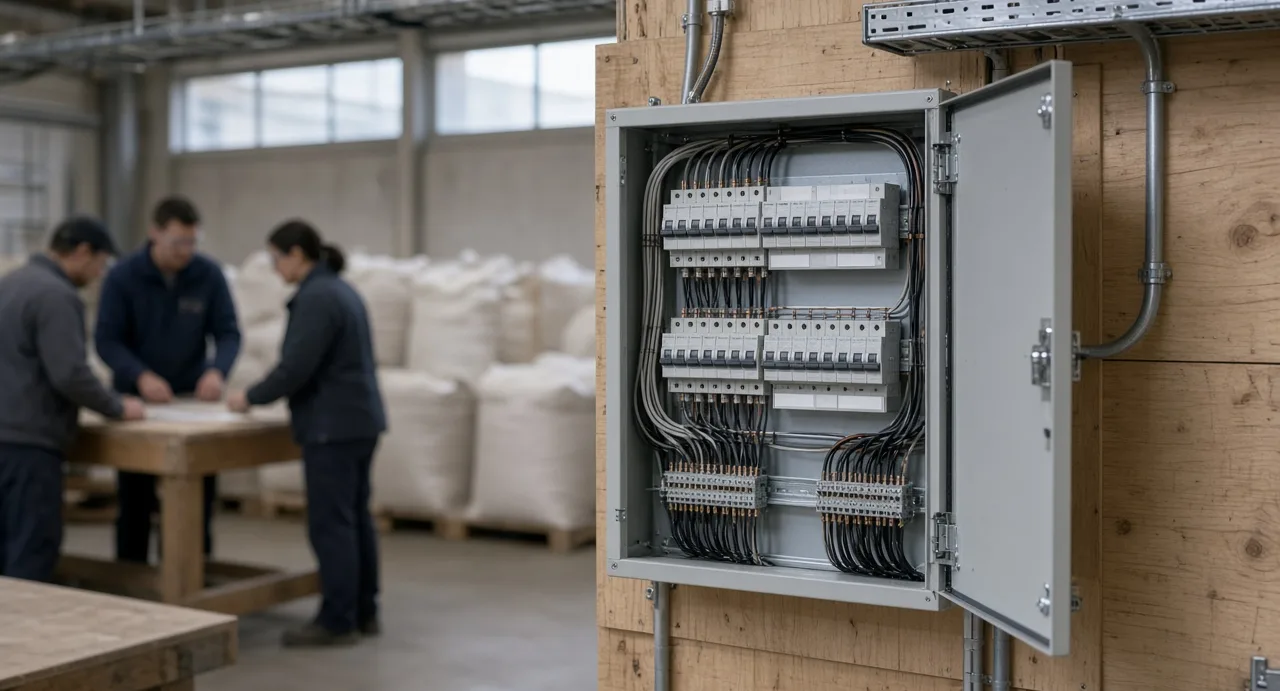
Bakery refit, Calder Quay
Joel Haddad · Year 2
Working on a commercial bakery refit in Calder Quay, Year 2 apprentice Joel Haddad undertook the complete assembly and termination of a new 14-way distribution board. In a demanding catering environment where moisture, flour dust, and continuous machinery loads are present, neat cable routing and unambiguous circuit identification are essential. Joel dressed each circuit cleanly into the enclosure, securing conductors with uniform spacing and labelling every outgoing breaker by hand and terminal tag. Lead instructor Rhea Lindqvist visited the installation to inspect terminal torque settings, phase identification, and earth continuity before formally signing off the board as completed.
Signed by Rhea Lindqvist · Year 2
(02)
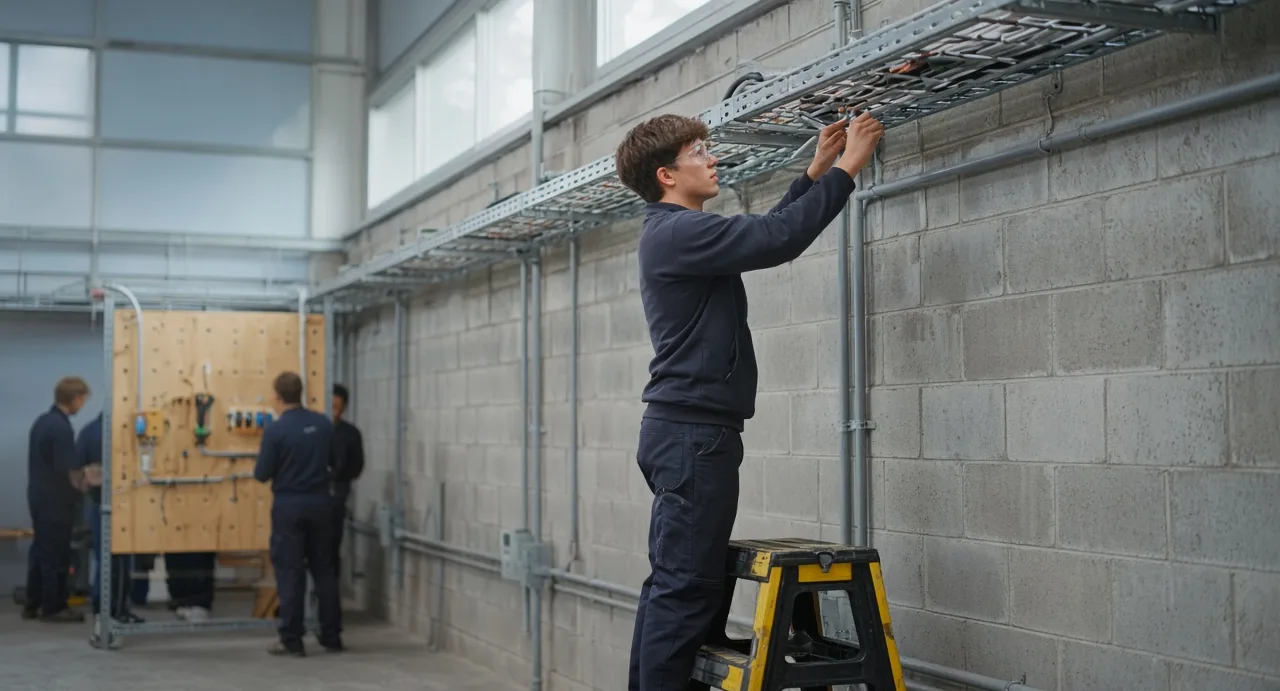
School sports hall
Amira Sesay · Year 1
During a major refurbishment of a school sports hall, Year 1 apprentice Amira Sesay installed a continuous 38-metre run of galvanised cable tray suspended at a height of four metres. Working safely from mobile podium steps, Amira measured, fabricated, and secured multiple bracket supports across the steel structural columns. She formed neat factory-quality factory bends and level joints along the full length of the wall. Cables were dressed with uniform spacing and strapped cleanly to withstand structural vibration. Rhea Lindqvist reviewed the completed containment run on site, inspecting bracket load ratings and tray alignment before signing the assessment sheet.
Signed by Rhea Lindqvist · Year 1
(03)
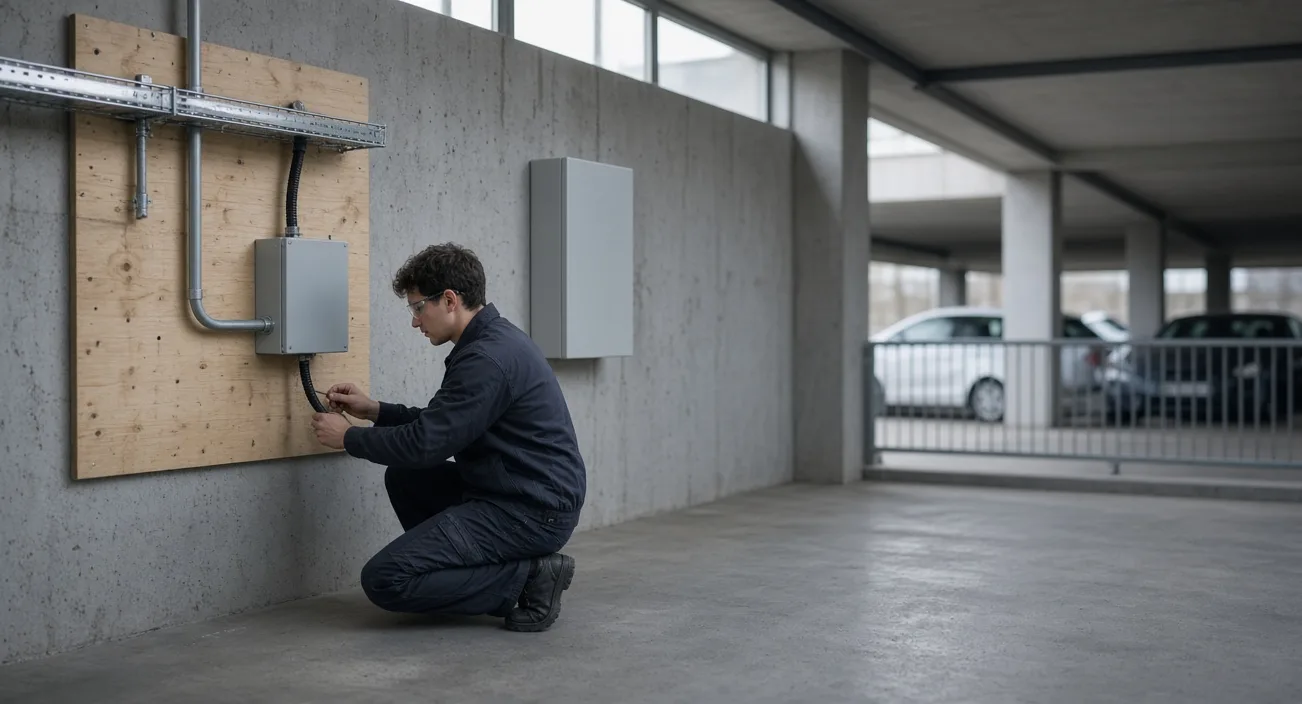
Housing co-op car park
Sven Aalto · Year 3
At a community housing co-op car park, Year 3 apprentice Sven Aalto was tasked with installing a dedicated vehicle charging circuit. The installation required running heavy armoured cable along external brickwork and terminating it securely into an industrial isolator next to a wall-mounted charger. Sven stripped the outer protective sheath, formed a clean brass gland termination with correct armor clamping, and torqued all mechanical joints to specification. Site assessor Paloma Iturbe conducted a formal site observation during the installation, watching Sven verify the earth loop path and weatherproofing seals before adding her signature to his practical log.
Signed by Paloma Iturbe on site · Year 3
(04)
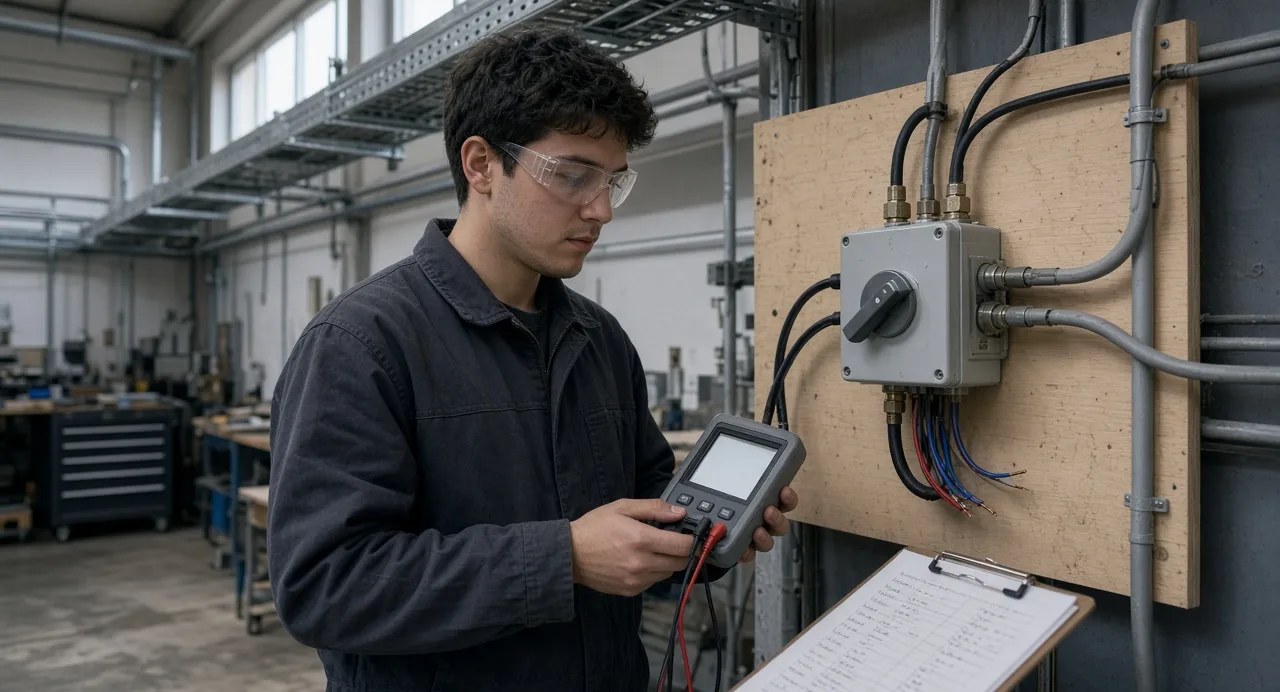
Lift motor room
Noor Rahimi · Year 3
In the motor room of a high-rise lift installation, Year 3 apprentice Noor Rahimi conducted diagnostic fault-finding and complete electrical verification on a commercial motor isolator. Working systematically with calibrated test instruments, Noor traced an intermittent control circuit fault, verifying continuity and insulation integrity across all phases. Following the repair, she compiled an inspection test sheet entirely by hand, recording exact meter readings and resistance calculations. Instructor Kofi Mensah reviewed her diagnostic logic and audited the hand-written test documentation against digital meter logs before signing off the completed piece.
Signed by Kofi Mensah · Year 3
The six pieces required for annual completion
Every apprentice's progress is measured against six concrete pieces of evidence produced each year. These six deliverables must be submitted in strict sequence: the distribution board, the cable tray containment run, the armoured cable gland, the hand-written test sheet, the assessor's site visit evaluation, and the monthly countersigned employer logbook. Instructors inspect each piece in person. There are no automated assessments, multiple-choice shortcuts, or surrogate assignments. A year of apprenticeship is only certified when all six signed pieces have been inspected, approved, and filed in the student’s permanent record.
Come and terminate a cable on a Saturday.
Open board Saturdays run on the first Saturday of each month from 09:00 to 12:00. Attendance is free: you try a termination with an instructor, in the workshop.