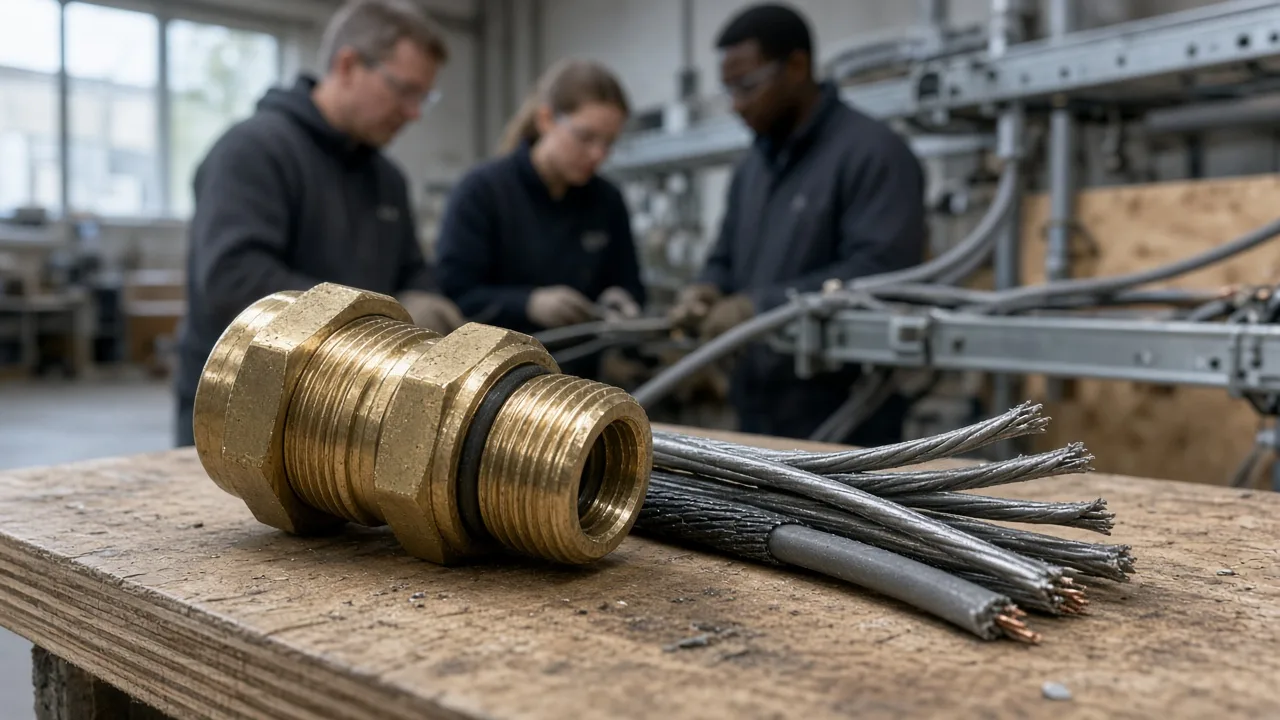
Every electrical apprentice remembers the first time they prepare an armoured cable. In bay two of our Calder Quay workshop, lead instructor Rhea Lindqvist places a length of steel-wire armoured cable, a brass compression gland, and a pair of hacksaws on the plywood bench. To a newcomer, the cable appears formidable: a thick outer sheath of black PVC, a rigid layer of spiralled galvanised steel wires, an inner bedding, and four insulated copper cores inside. It is heavy, inflexible, and unyielding. The task sounds simple on paper: remove the outer sheath to an exact measurement, flare and cut the armour wires uniformly, seat them squarely into the gland cone, and tighten the brass locknut into a cast metal isolator. Yet within twenty minutes, that single cable gland tells an instructor almost everything they need to know about an aspiring electrician.
The first thing the gland reveals is patience. Strip the outer PVC jacket too hastily with a utility knife, and you score the galvanised armour beneath, introducing a point of mechanical weakness and future corrosion. Score deeper still, and you nick the inner bedding, compromising the electrical separation between phase conductors and earth. An apprentice who rushes will inevitably produce ragged armour wires of unequal lengths. When tightened down, uneven wires bunch up on one side of the brass cone, cocking the gland at an angle and preventing the rubber sealing ring from making a true watertight seal. You cannot bully a brass gland into sitting flush. It demands measured scoring, clean circumferential cuts, and careful hand dressing with a light file to remove burrs.
The second quality the gland exposes is spatial precision. When Rhea inspects an apprentice’s work at the training board, she does not simply glance at the exterior. She checks whether the brass shoulder sits tight against the enclosure wall without distorting the metal knockout. She inspects the internal earth tag, verifying that the copper continuity conductor is routed neatly and torqued down with a lock washer. A cable gland is not merely a physical clamp to keep a cable from falling out of a box; it is the vital earth-fault return path for the entire circuit. If an armoured cable is struck on a construction site, that ring of steel wires carries thousands of amperes of fault current back to the source to trip the protective breaker. If the gland is loose, painted over, or missing its internal serrated washer, the earth path fails, and metal enclosures become lethal.
Finally, the gland demonstrates how an apprentice respects tools. In week one of the foundation term, students receive their tool kit and learn to use torque spanners rather than gripping pliers on brass hex nuts. Rounding off the corners of a brass gland with worn water-pump pliers is a hallmark of sloppy site habits. In our workshop, tools are counted at 15:45 every afternoon, and every gland is torqued to manufacturer specifications. When Joel Haddad refitted the bakery distribution board in Calder Quay or when Sven Aalto installed the car park charger isolator, their glands passed inspection because the habits formed in bay two held firm under site pressure. A gland terminated with care tells everyone who opens that enclosure that an electrician, not an amateur, was here.