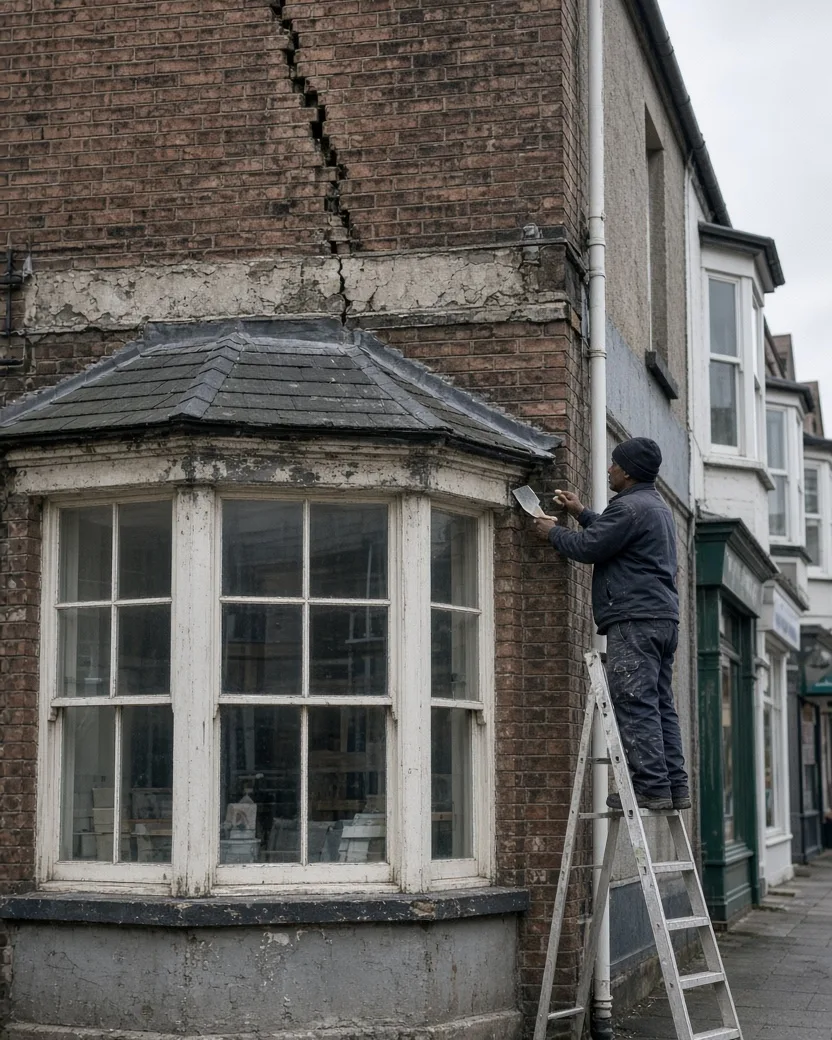
A brick lintel is the row of bricks over a window or a door. On a 1920s terraced house it often carries the bay at the front. When those bricks crack, the crack is easy to walk past. A viewing lasts about twenty minutes and is spent on light and space, not on the lintel over the bay. We go to look at the fabric before a buyer signs, and the lintel is one of the first things I look at from the pavement.
I survey houses for Noki Surveyors. Tomasz Wren is the name on those reports. On a two-bed 1920s terraced house the front bay had a cracked brick lintel. The crack stepped up through the mortar. The lintel had dropped about 4 mm. That is not a wide gap, and it is not a reason to invent a storey about the whole terrace. It is enough to say the brickwork over the opening is no longer sitting as it was built. The photograph shows the step in the mortar. The sentence under it has to be as plain as the photograph, because the buyer will read it at the kitchen table and then decide whether to phone the seller.
The report said the lintel needed replacing before winter. We wrote: replace before winter, ask the seller. That is a now item, not a keep-an-eye-on item. Winter rain works into an open joint, and a lintel that has already dropped is the wrong one to leave for a later year. The buyer was Ruth Bell. She agreed the repair with the seller before signing. We did not arrange the work. We do not sell or arrange repairs, and we do not work for the seller or the agent. The priorities column carries a rough cost range so the conversation has a scale. The range is not a quotation from us.
A cracked lintel is not always the same finding, which is the point of measuring it rather than naming it. Some cracks sit in the pointing and do not step into the bricks above. Some run out from the corner of a window and stop in the plaster inside. I measure the crack width, I look at which way it steps, and I look at whether the lintel has dropped. Those three things decide the sentence. A crack that does not step, over a lintel that has not dropped, may belong in keep an eye on, or in within two years. A crack that steps, on a lintel that has dropped, belongs in now when the opening is still carrying the wall above it. I do not treat every cracked brick as a structural problem. A dropped lintel is also the wrong thing to paint over and forget.
The rest of the ledger is still written on the same visit. Structure and movement is the first of eight sections. Roof and rainwater, damp and ventilation, walls, windows and doors, the services we can see, the inside of the house, and the ground outside all have their own notes. Services are visual only. I do not test the electrics, the heating or the drains because a lintel has cracked. I do not lift fixed floors. I do not walk on the roof. Ladders go to about 3 m, and above that the pole camera and binoculars do the looking. If the lintel needs a structural engineer, I say so on the call and name that kind of specialist. The buyer instructs them. The report goes to the named client, and then we talk for thirty minutes. Ruth’s house followed that path.
Her instruction was a full house survey, not a single-defect inspection. A single-defect inspection is one crack, one damp patch or one leak, on site for about forty-five minutes, and the letter comes back in two working days at EUR 290. A full report on a house of 90–180 m² takes 2 to 3 hours on site and comes within five working days. The price is EUR 640, including VAT and travel within 40 km of Elsmere Quay. A smaller flat, up to 90 m², is about ninety minutes and EUR 480. Someone has to let us in. The buyer is welcome for the last twenty minutes and does not have to stay for the rest. You pay after the report is sent, within 14 days.
None of this is a valuation. The report does not say what the terrace is worth, and it does not claim to have found every hidden defect. The lintel was visible from a short ladder. It had dropped about 4 mm. The plain sentence was to replace it before winter and ask the seller. Ruth agreed that repair before she signed. That is the finding doing the job we founded the practice to do in 2011: the condition of the house, written down, while there is still time to talk about it.