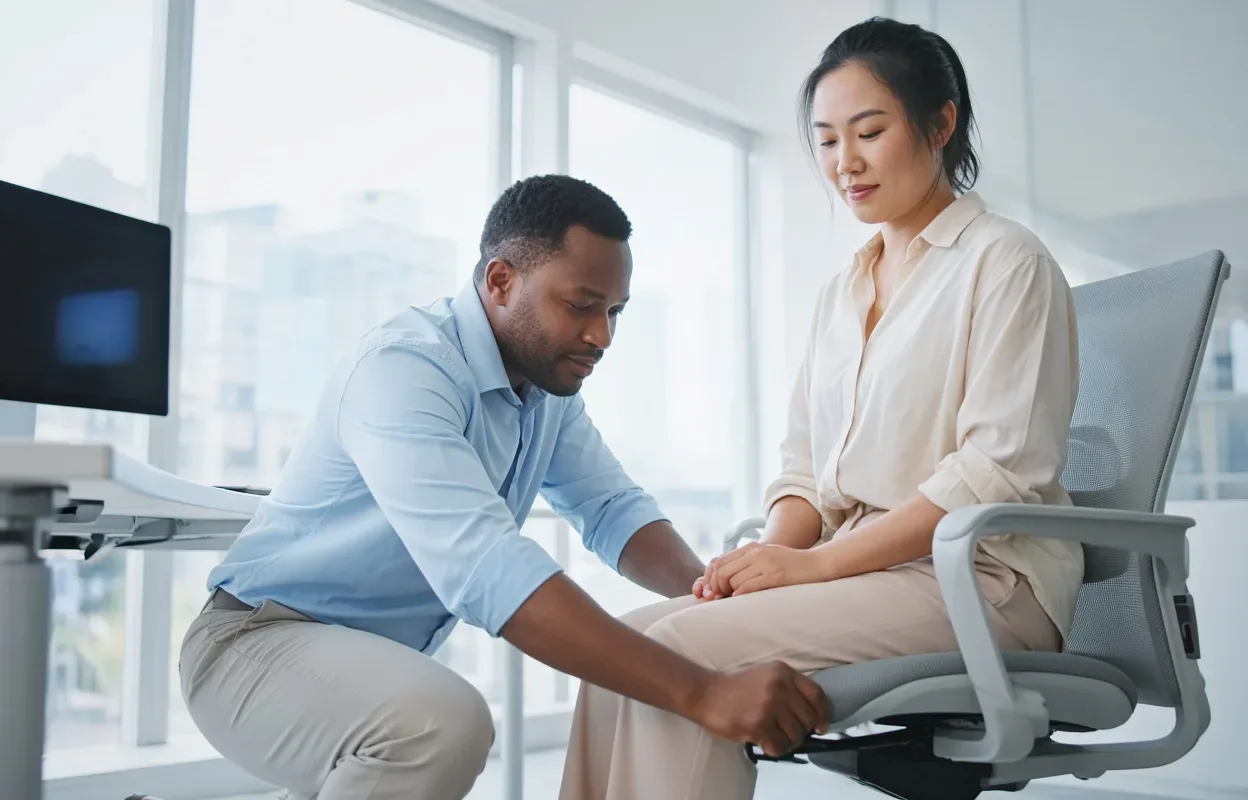
A desk session in a readiness review lasts twenty minutes, at the person’s own desk, while the rest of the floor keeps working. The first ten minutes of that twenty are not for adjusting levers. They are for watching the desk that is already in use. We would rather see the ordinary set-up than a chair pulled into a polite position because a visitor has arrived.
The screen comes first, because it is the easiest thing to misjudge from across the room. The person works as they usually do. We look at the top edge of the monitor against their eye line. A flat hand at that top edge is enough to show both of us whether the panel is high, low, or already where it should be. Distance matters as well, and so does glare if a window is washing the glass. We are not scoring the monitor. We are asking whether this person can see their work without lifting the chin or leaning in. If a laptop is the only screen, the same question applies, and it is usually answered badly when the keyboard in the lid is the one being typed on. The screen and the hands want different heights. That conflict is visible in the first minute.
The chair is next, and it is judged as it is set today, not as it might be set. Seat height, how deep the person sits, where the backrest meets them, and what the armrests are doing under the elbows: those are the points. Many chairs on a floor of twelve or of thirty were set for someone else and never moved again. The first ten minutes often show a good chair doing the wrong job. We do not announce that. We watch the shoulders and the feet while the person writes or takes a short call. A chair that looks expensive and a chair that looks plain can fail in the same way if the levers have not been touched since the day it was unpacked.
Elbow and foot belong together, which is why we mark them as a pair with the screen. Once the shoulders are down, the elbow says whether the desk is near the right height. The feet say whether that height has left them unsupported. A sit-stand desk does not escape the question. We look at the height it is actually set to this morning, including when everyone on the floor has been told to stand and has done so for the whole shift. Standing can be the right place for part of the day. Standing as the only place is something we have had to write down and then change. The change, when it comes, is written for that person. It is not a slogan about movement.
The keyboard is the last look before anyone touches a lever. How far it sits from the body, and whether the shoulders rise to meet it, tells us more than a debate about wrist angle. If the person is on a laptop, we note whether a separate keyboard is already in the drawer. We do not produce one in the first ten minutes. Lending or listing kit comes later, and only when the watch has shown that the lid cannot be both screen and keyboard.
What we will not do in those ten minutes is diagnose. Sore shoulders, sore feet and tired eyes may be mentioned, and we listen. A medical condition is referred to a physiotherapist or a doctor. The review is advice about the desk. Ilse Varga’s background in hospital rehab is why the practice exists; it is not a reason to turn a workstation visit into a clinic.
The second half of the twenty minutes is when small fixes happen, and only the ones the first half has earned: a seat height, an arm, a screen raised on the arm that is already there. Anything larger waits for the written page. Changing the least is a rule we can keep only if the looking was real. By the time the findings conversation starts at 16:30, the manager should be hearing what was seen at each desk, not a general opinion of the furniture. The plan, one page per person plus a floor summary, is how that looking survives after we have packed the bag and left.