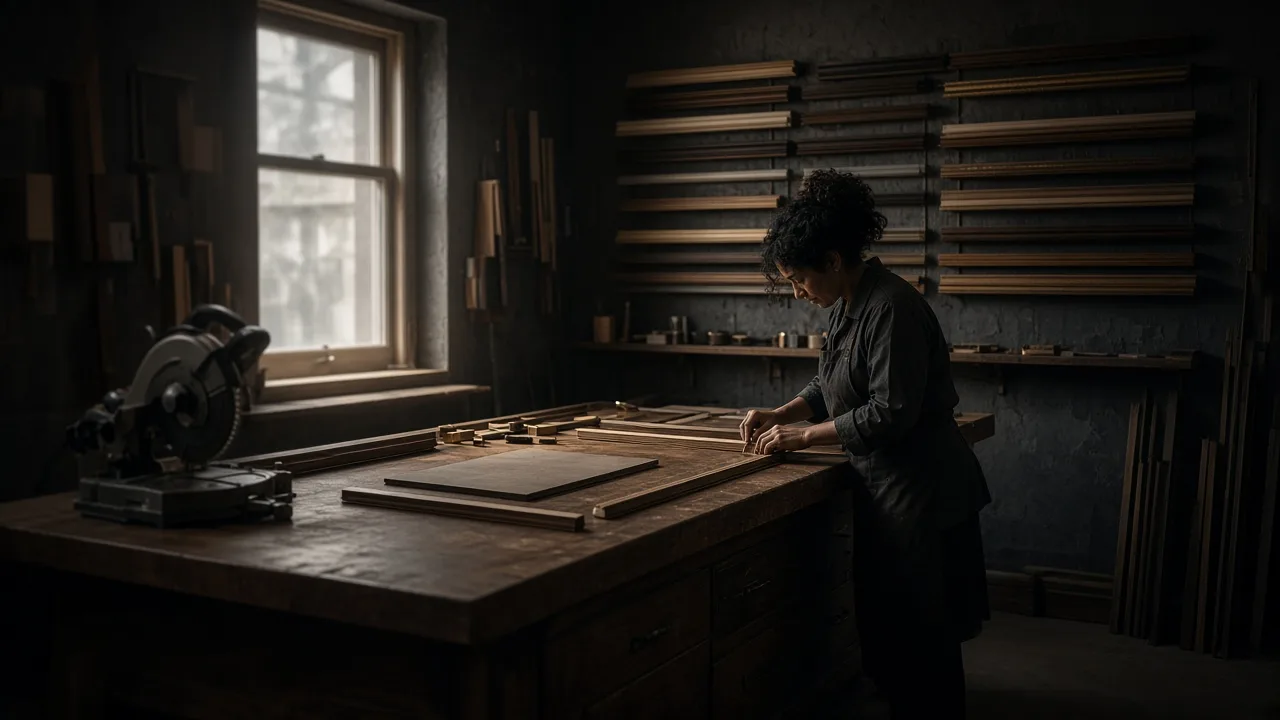
Walk past the front counter at 27 Cooper’s Yard in Halden and you will see Nadia Sørensen standing over our long workbench, holding a steel straight edge against a fresh sheet of conservation board. There is no automated computer-guided cutting table humming in the corner. There is only the quiet slide of a hardened steel blade guided by a steady hand, moving at a measured pace through dense conservation board. Mira Haldane established Gaku Frames in 2011 with the conviction that picture framing should remain an intimate, tactile craft, and cutting mounts by hand remains central to that standard.
A mount does far more than create decorative breathing space around a picture. Architecturally, it establishes an essential physical barrier that prevents delicate artwork paper from touching the glass, protecting fragile ink or pigment from condensation and temperature shifts. Visually, a clean forty-five degree bevel creates a subtle shadow line that leads the viewer’s eye into the composition. When a bevel is cut by hand along a rule, the corner stops are judged by touch and sight, ensuring crisp, seamless junctions without the unsightly over-cuts or ragged corners frequently produced by automated commercial machines.
Every mount we cut uses acid-free conservation board. Over decades, standard wood-pulp boards release acidic chemicals that migrate into artwork, causing characteristic yellow halos and irreversible paper embrittlement. To prevent this deterioration, we stock seven mount colours: five distinct whites and two soft greys. Matching a mount to artwork requires careful evaluation under natural daylight at our counter. Rather than forcing a bright, bleached white that makes vintage paper look cold or soiled, Lucía Moreno and Mira help clients select a tonal shade that echoes the natural base tone of the print.
Once the mount window is cleanly cut, the print must be secured. We never use pressure-sensitive adhesives, masking tape, or dry-mount films that permanently bond paper to backing. Instead, Nadia applies reversible hinges using archival conservation tape. The print hangs suspended from its top margin like a curtain, allowing the sheet to expand and contract naturally as room humidity changes throughout the year. If the print ever needs to be removed for conservation or reframing decades from now, Priya Nair can release the hinges cleanly without damaging the underlying paper fibres.
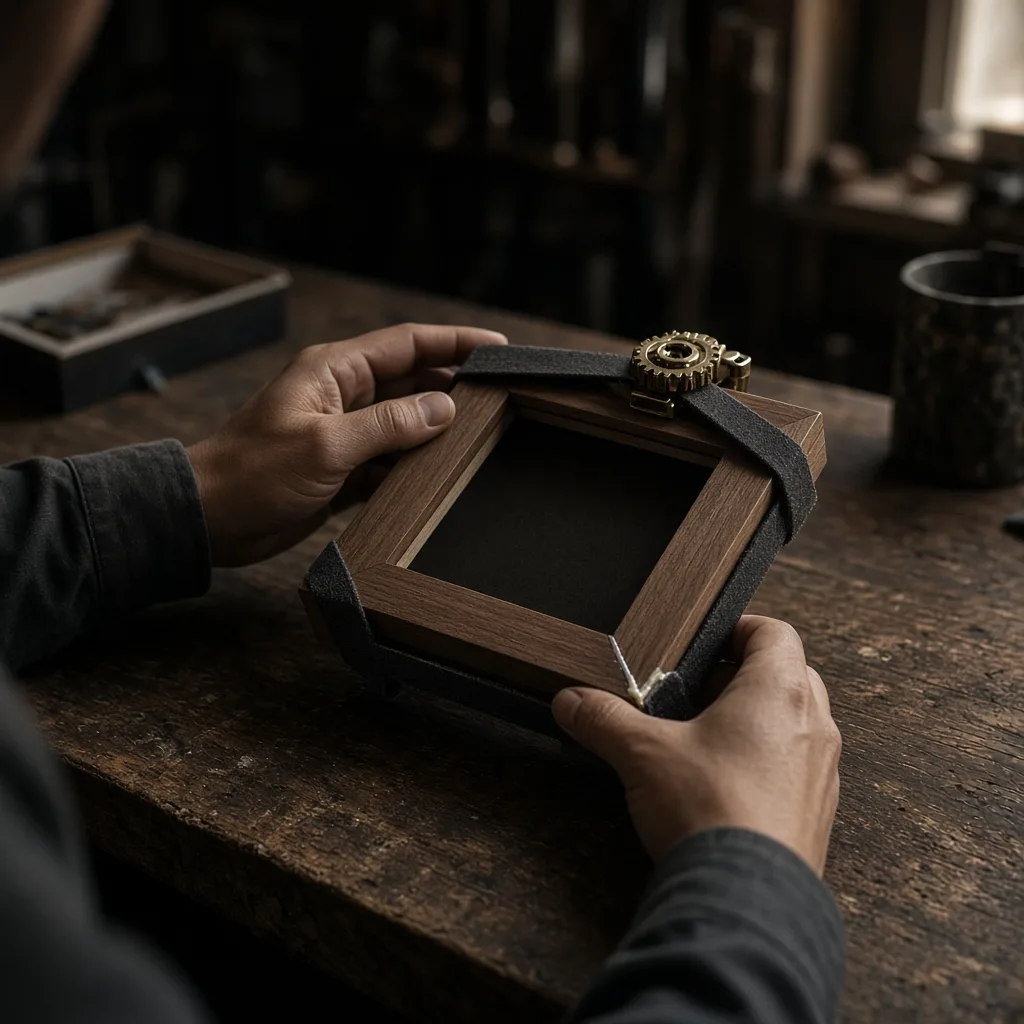
After mounting, the assembly moves across the bench to Kwame Boateng for glazing and final fitting. Whether fitted with standard float glass or anti-reflective, UV-filtering museum glass, the rebate is sealed against airborne dust and humidity. Tomas Reyes joins the mitred timber corners in oak, walnut, ash, or maple, while Eli Brandt prepares finished pieces for our Tuesday and Friday hanging rounds. The entire sequence—measuring the print and wall, cutting the bevel, hinging the paper, and glazing the frame—takes patience, precision, and practiced coordination across our seven-person team.
Automated cutters may process dozens of boards in an hour, but they cannot evaluate the subtle curl of handmade paper, the variable margins of an etching, or the wall where the frame will ultimately hang. By cutting every mount by hand on our bench in Cooper’s Yard, we ensure each finished frame honors both the artwork and the room it is made to inhabit.