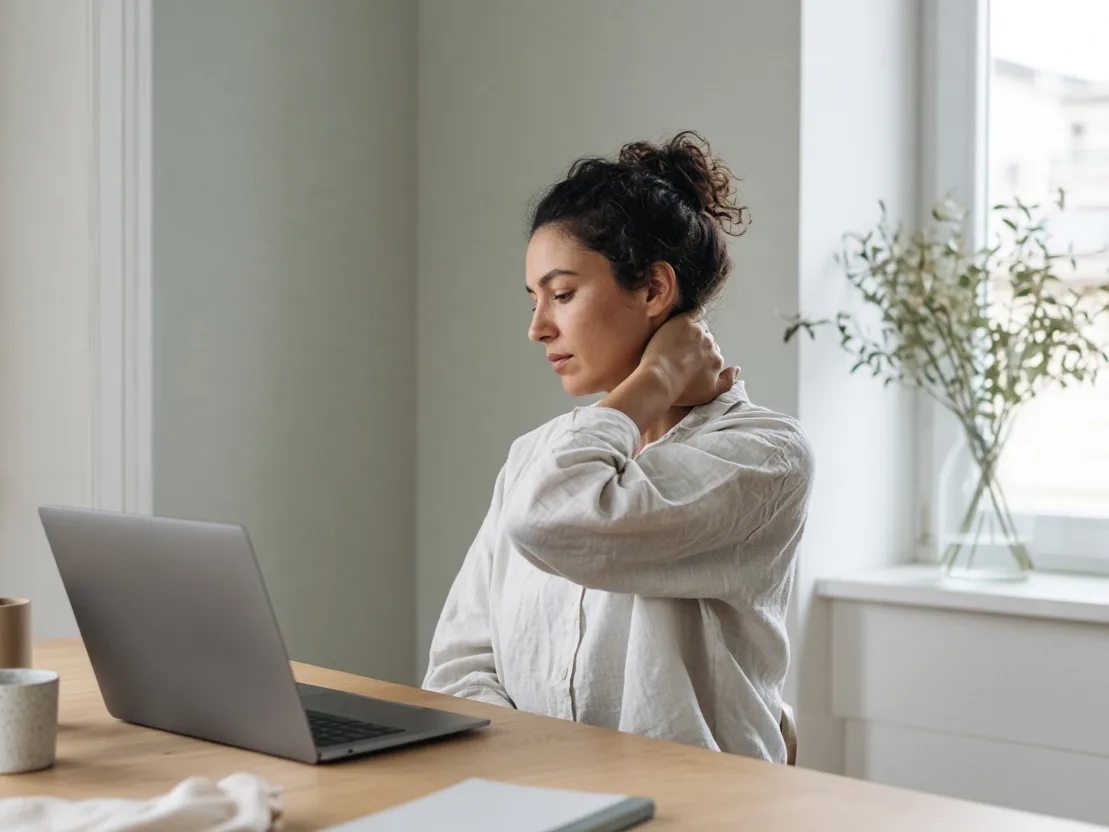
I am Maren Holt, an osteopath at Teate Clinic in Halbrook. I share the practice with Kofi Mensah. We opened it in 2014, and my days in the room are Monday, Tuesday, Thursday and Saturday. Most of the people I see work at a desk. They rarely arrive with a single dramatic moment. They arrive with stiffness, with a headache that shows up at the end of the day, and with a shoulder that sits up toward one ear. The three changes below are the ones I suggest most often in the last part of a visit, when we write a plan. They are small on purpose. They sit beside hands-on care. They are a general note for desk work, which is why this piece is filed under that category, with the tags neck and exercises.
The first change is the height of the screen. If you look down for most of the day, the neck holds that shape until the afternoon, and the shoulder on one side often joins it. Raise the screen until your eyes can look across at it and the shoulders can stay quiet. I am not asking you to buy a named product. Use whatever you already have, as long as it is stable and the screen genuinely comes up. Daniel Okafor, an accountant who came after the year-end deadlines, changed his screen height as part of his care. Across four visits over six weeks he also learned two exercises. Afterwards he could check over his shoulder on the bike again without turning his whole body. His result is his own. A higher screen is still the first thing I look at when a desk day and a stiff neck arrive together.
The second change is to break up long sitting. A neck and a lower back often share the same day: one chair, one task, and no reason to stand until the work is finished. You do not need a timed programme for this. You need a reason that already exists. Stand while you take a call. Walk across the room to speak to someone instead of writing another message. Fill a glass of water and drink it away from the desk, then sit again with both feet on the floor. Tomás Rivera, a designer we saw for his lower back after he moved house, learned this as how to break up long sitting, over three visits. The same habit helps a neck that only stiffens after lunch. When you sit, let the shoulder that has crept up drop before you start typing again.
The third change is a quiet movement in the chair. Sit so the shoulder blades rest down on the back of the ribs. Turn your head the way you would look over a shoulder on a bike, slowly, one side and then the other, and stop before the turn feels sharp. Let the arms hang for a moment and notice which shoulder has ridden up. That is the whole of this general exercise. In the clinic I give two or three exercises only after I have watched you move, and those are chosen for you. This one is the version I am willing to put in a note for ordinary desk stiffness. If turning the head brings numbness, stop. Numbness, like fever, night pain or a fall, is a reason to see a doctor. We do not keep treating through those, and a note is the wrong place to push on.
These three changes do not replace a visit. In the room the first hour is 60 minutes and costs EUR 95. Ten minutes are talk about where it hurts, when, and what makes it better or worse. Fifteen minutes are for watching how you stand, sit, bend and walk. Twenty-five minutes are hands-on treatment. The last ten minutes are the plan, which is where screen height, sitting and two or three exercises usually land. Hands only: no machines, no ultrasound, no needles. Many people need two to four follow-ups over a few weeks. Some need only one. We say so honestly. A follow-up is 40 minutes at EUR 70. If the trouble is a knee, an ankle or a hip from running, cycling or swimming, that work belongs with Kofi, on Monday, Wednesday, Thursday and Friday evenings.
If you want to try the three changes before you book, try them gently and stop if they irritate you. If the neck is still running the end of your day, book a first visit. Arrive 5 minutes early, wear clothes you can move in, and fill in the one-page form. Inès Laurent at the front desk books every visit. Call +00 44 555 0172 on Monday to Friday between 08:00 and 18:00, or email hello@teate-clinic.example. Tell her where it hurts, which days suit you, and that this is a first visit. She replies within one working day. The clinic is at 14 Linden Row, on the ground floor, and the door is step-free. Evening slots from 17:00 to 19:30 are kept mainly for people coming from work, which suits a desk neck better than a rushed lunchtime for many of the people I see.