When restoration work began at Warehouse No. 7 in 2016, the exterior walls presented an immediate challenge. Built in 1924 on Pier 7 along Kessel Quay, the brick storehouse had endured nearly a century of coastal weather, salt air, and damp river winds blowing across Vessa Harbour. Decades of heavy maritime traffic and thirty years of disuse after the port closed commercial operations in 1987 had left the façade weathered. Rather than applying modern render or replacing damaged sections with contemporary industrial masonry, founder and architect Ines Varga established a strict principle for the conversion: the historical envelope must be preserved using authentic materials from the harbour itself.
Master mason Henrik Lund took charge of the masonry repair, committing to a slow, methodical process that lasted from 2016 to 2019. Inspecting the exterior bay by bay, Henrik discovered that several hundred bricks around the window arches and upper cornices had deteriorated beyond structural recovery. Instead of ordering new bricks from an outside quarry, Henrik looked across the pier. A short distance down Kessel Quay stood the remains of a collapsed loading shed from the same 1920s construction era, its fallen walls containing identical clay bricks fired in local regional kilns.
Over the following eighteen months, Henrik’s team dismantled the collapsed shed by hand, cleaning and salvaging thousands of intact bricks. Each salvaged brick was sorted by density, tone, and surface texture before being brought into Warehouse No. 7. Working on scaffolding erected inside and outside each bay, the masons removed damaged units one at a time, replacing them with the salvaged pier bricks. Henrik mixed traditional lime mortar without modern Portland cement, ensuring breathability and matching the soft, warm mortar lines originally laid in 1924.
The work required extraordinary patience. On cold autumn afternoons, with the tide rising against Kessel Quay, Henrik and his crew would set fewer than thirty bricks a day, checking levels against the original plumb lines of the warehouse. The salvaged bricks bore subtle colour variations—from muted umber and deep iron red to charcoal-dusted faces where coal smoke from old steamships had left its mark. By keeping these irregular surfaces visible, the team maintained the tactile honesty of the building rather than creating a flat, artificial uniformity.
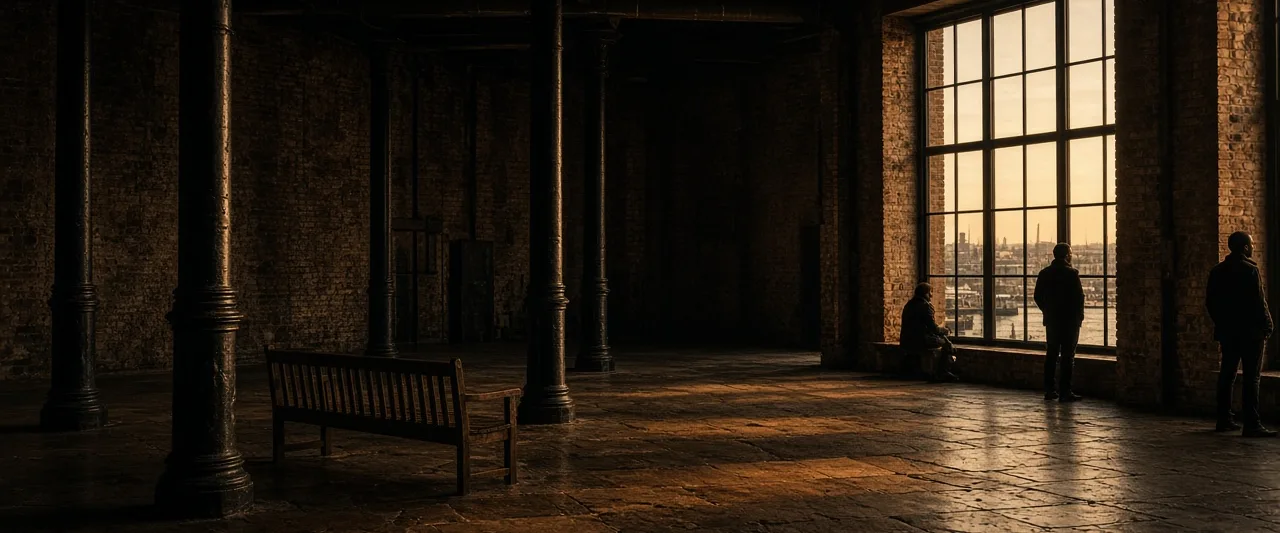
Every individual bay along the water reflects this deliberate conservation approach. Rather than masking the building’s age behind modern finishes, the weathered brickwork remains exposed inside guest corridors, private bedrooms, and the common rooms of the Canteen. When the restoration concluded in 2019, Henrik Lund and his team had stabilized all thirty-two rooms without stripping the building of its working soul. The bricks that once protected sacks of coffee and coils of rope now shelter overnight travellers, their coarse textures illuminated by the warm glow of bedside lamps and low-key steel wall sconces.
Today, guests approaching Door 7 along Kessel Quay can clearly see the subtle patchwork of Henrik’s repairs across the broad façade. In the late afternoon, as the sun descends over Vessa Harbour and casts long shadows across the pier, the brick arches catch the raking light just as they did in 1924. The warehouse stands neither as an untouched ruin nor as a sterile replica, but as a genuine continuation of harbour history. It remains a place where the physical marks of past industry and human hands are preserved, quiet and enduring, beside the evening tide.