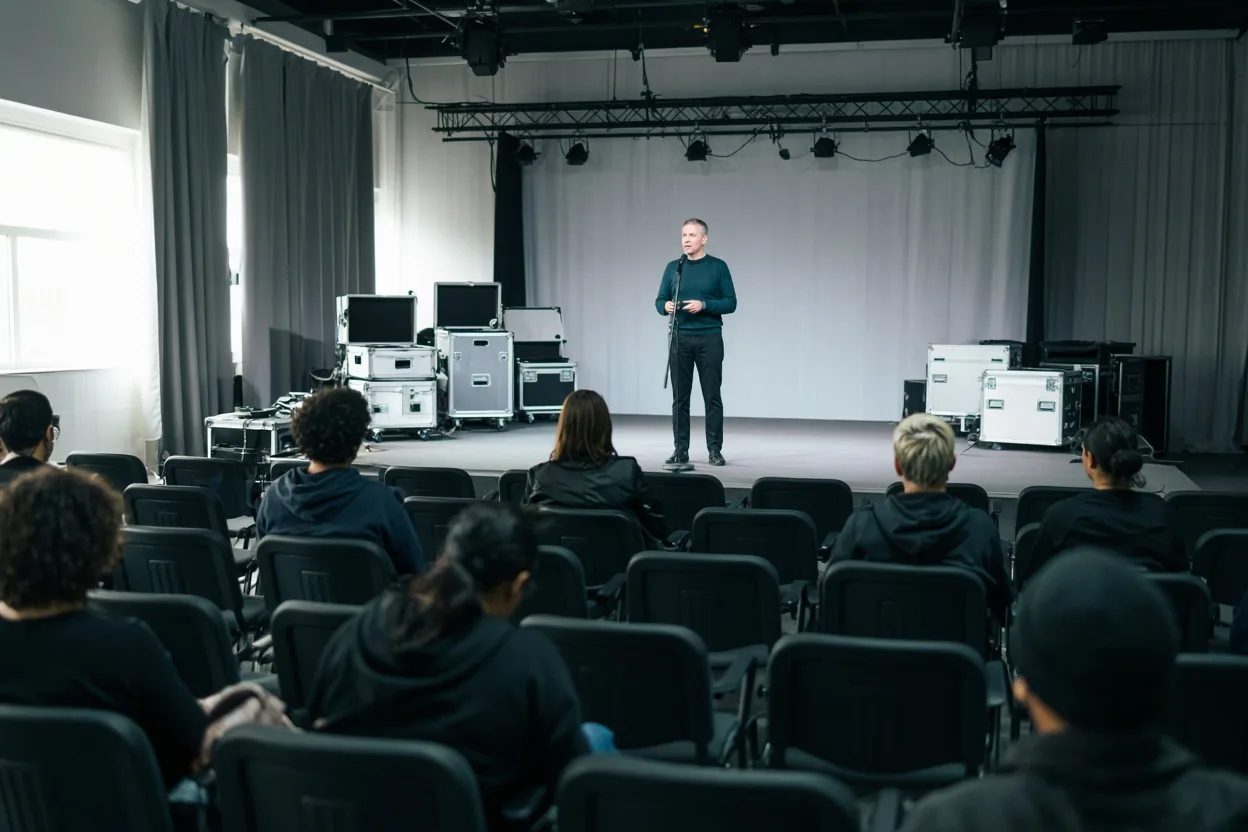
In live event production, panic is rarely caused by faulty equipment. It is caused by ambiguity. When technicians, camera operators, lighting engineers, and executive handlers share an exhibition hall, everyone needs to know exactly what happens next, who initiates it, and when it must occur. This is what a cue sheet is for. Far from being a simple agenda or speaking schedule, a true cue sheet is an operational contract. It translates hours of creative intent and technical calibration into a single, chronological ledger that governs every second of a live show.
At Moyooshi Productions, our cue sheets are built through an exacting method refined across 214 productions since 2014. During the six-week preparation window between initial brief and show day, our four desks—Production, Technical, Stage, and Logistics—contribute directly to its development. The document establishes the key operational criteria for every single transition: the trigger, the caller, the action, and the recovery state. If an executive walks toward a lectern, the cue sheet does not merely say “speaker enters.” It specifies the exact spoken word or visual movement that prompts stage manager Tomasz Okafor to call the cue, the radio channel he speaks across, the precise lighting preset Kenji Arata triggers, and the exact fader movement Ines Duarte initiates at the audio console.
This level of precision is tested and finalized during the 14:00 rehearsal milestone on show day. Following the 06:00 load-in and 10:00 line checks, rehearsal provides the single opportunity to run the cue sheet in real time with presenters. Here, pencil marks replace digital drafts. If a presenter delivers a punchline faster than anticipated, or pauses before introducing an award recipient, Tomasz Okafor adjusts the cue line directly on the master document. The prompt desk becomes the absolute source of truth for the entire hall. When doors open at 18:30, our 38 on-call crew members are aligned to the identical sequence, eliminating hesitation and backstage guesswork.
The real power of a disciplined cue sheet reveals itself during moments of deviation. Live events inevitably produce unexpected occurrences: a remote video caller loses audio, a presenter skips two slides, or an award winner walks up the wrong aisle. Without a cue sheet, crew members attempt to guess the producer’s intention, resulting in jarring audio cuts or spotlights searching across an empty stage. With a rigorous cue sheet, the stage manager can hold, skip, or modify cues systematically. The crew remains composed because deviations are handled as controlled technical branches rather than operational emergencies.
Ultimately, the cue sheet serves the audience and the client by rendering production invisible. When lighting states shift imperceptibly, microphones open at the exact breath of a speaker, and presentation graphics snap cleanly to video walls, the audience experiences complete immersion in the message. They never see the flight cases, the radio headsets, or the prompt desks. That calm authority is not accidental. It is the direct result of a master cue sheet, drafted with technical discipline and executed with unwavering focus from the first load-in box at 06:00 to the final strike call at 23:30.