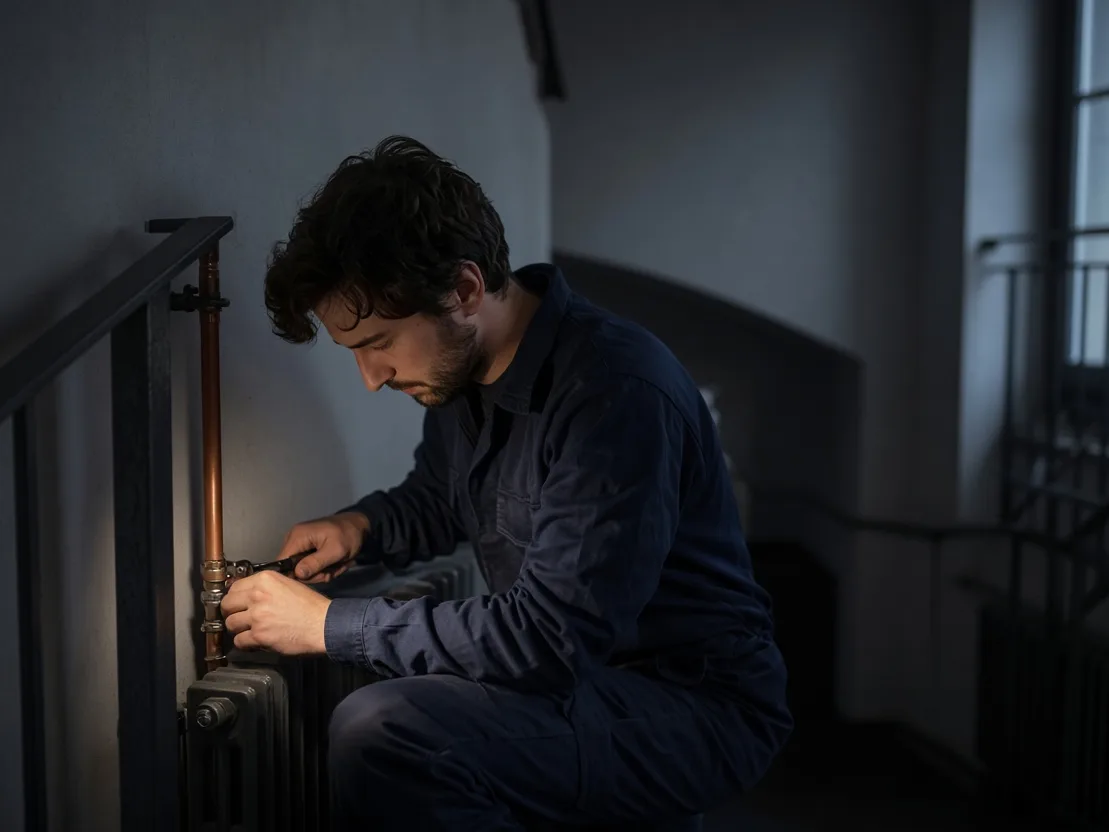
The pressure test sits in the afternoon, and in the first month it is the hour that makes the morning honest. I run Bench Hall B. The boiler rig is in that hall. From 13:15 to 15:00, 105 minutes, two apprentices share a rig. One watches an analogue gauge. One walks the pipe. I stay close enough to hear what they say when the needle will not settle.
The morning has already been long. Tool check and the toolbox talk run from 07:45 to 08:00. Bench block one, 08:00 to 10:15, is cutting, bending, and jointing. After the break, 10:15 to 10:35, the second block runs to 12:30 on the piece set for the week. Lunch is 12:30 to 13:15. By the time you reach the rig, the joint you are about to test is one you made yourself, under a task lamp, in a hall that is otherwise dim. Nobody is good at soldering in week one. By June you will not remember why it was hard. The afternoon test is where a poor joint stops being a private opinion. You put the piece you made onto the rig, you watch the gauge, and you see whether it stays still.
I do not ask anyone, in month one, to chase a number off the dial. I ask them to see what the needle does, and to find the joint if the test will not settle. Two people often share the rig, one reading the gauge and one walking the pipe. If something weeps, the work is to say where, not to hide the fitting and hope the next test is kinder. A test that only ever passes has not taught you how to look. Fault-finding on this block is slow on purpose. The hall around the rig stays dim. The task lamp is the light you have.
At 15:00 the block stops. The last half hour, to 15:30, is the logbook, the sign-off, and a swept bay. The entry for a pressure test is plain: what was on the rig, what the gauge did, what you changed, and who signed. Those pages are the bench assessments in everyday clothes. The line on the fee list is the bench assessments and the signed logbook, EUR 220 per year. We do not attach another qualification’s name to it. I care that the page written before 15:30 matches the rig we both stood in front of. The whole Monday-to-Thursday day, from the 07:45 tool check to that sign-off, is 465 minutes.
Friday changes the room, not the standard. Luis Carvalho has the theory morning, 08:30 to 12:30, on water regulations, heat loss, reading drawings, and safe working. Lunch is 12:30 to 13:15. From 13:15 to 15:30 the bench is open for practice and resits. If a first-month test was messy, Friday afternoon is a proper place to repeat it. Hana uses those Fridays the same way when soldering is still behind. She kept Farid Haddad back on Fridays through a slow first term, and the open bench is there for that kind of catching up. The year is 38 teaching weeks, September to July, four bench days and this one theory day. The pressure test does not get a special week of its own. It sits inside the ordinary afternoon, after lunch, for 105 minutes.
People sometimes ask, in the first month, whether a settled test means they are ready for a firm. It does not. Year 2 is a placement year, four days a week with one of 18 partner firms within 40 km of Wrenfield, and Fridays back here. Grace Mwangi visits once a term. There are three visits in the year. A placement is a training year, not a job offer. Many firms do keep their apprentice on; we never promise it. The firms are seven small heating firms, five housing maintenance teams, four commercial plumbing contractors, and two heat-pump installers. A still gauge in the first month is worth writing down. It is not a job letter, and it is not the June assessment of Year 2.
The course around this hour is the one we have always run from the old foundry workshop Rosa Lindqvist and I opened in 2009, with six benches. Year 1 is EUR 4,800. The starter kit in week 1, a cutter, a bender, grips, a torch, and a case, is EUR 640, and it is yours to keep. None of that kit turns a first-month test into site work. There is no gas work on live homes in Year 1. The rig is a practice rig.
If you are deciding whether the course is yours, come and see the rig before you apply. Taster Saturday is the first Saturday of the month, 09:00 to 15:00, not in August. The Saturday timetable reaches the boiler rig at 13:00, after lunch at 12:00, and the day closes at 15:00. Boots and glasses are provided, lunch is included, and the day is free. No booking is needed for the morning. A Tuesday visit at 16:00 is shorter. The halls are step-free, on the ground floor at 22 Foundry Lane, Wrenfield. Applications for September close on 30 April. For the September 2027 intake, that is 30 April 2027. There are 24 places, two groups of 12. The bench morning we ask of applicants is 90 minutes, and nobody expects the first piece of pipe to be good. The point of the first month is that you learn to see what the work did, and you learn to say so in the logbook before you leave.