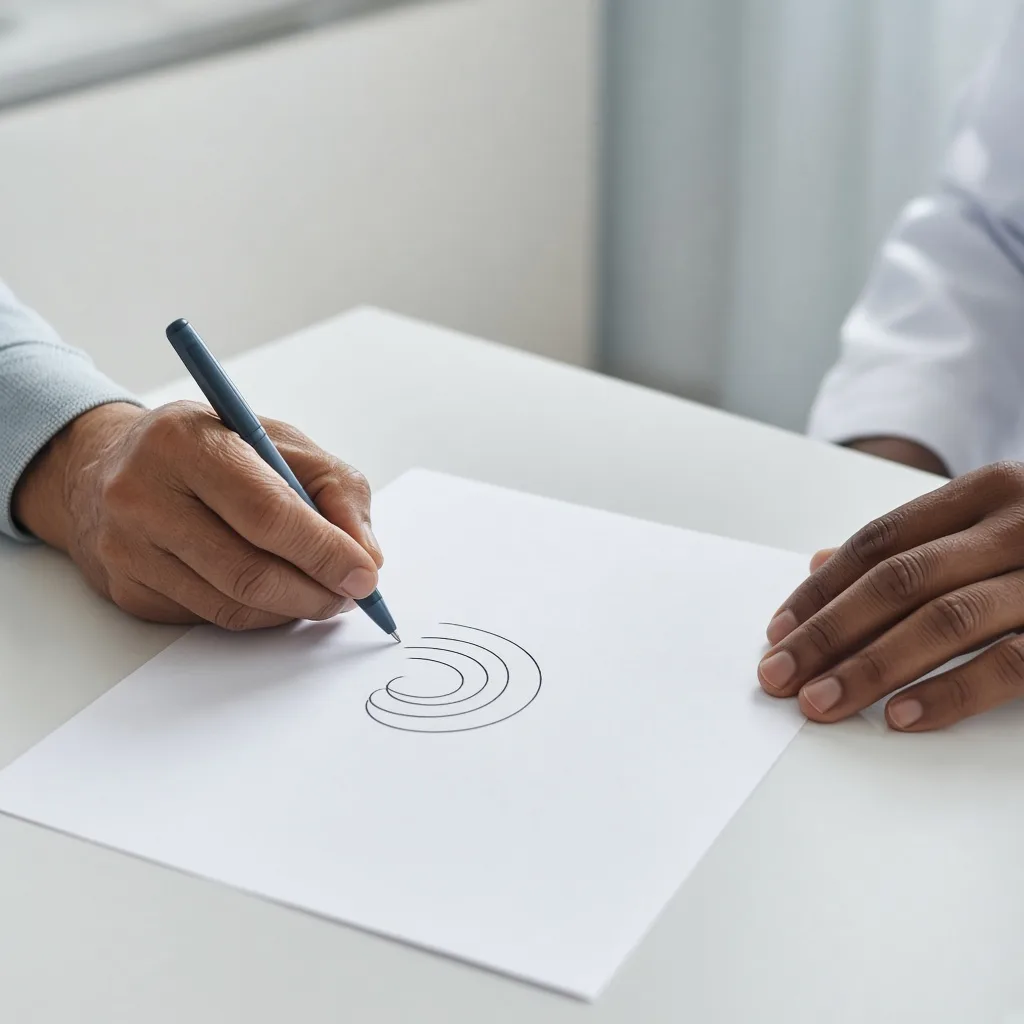
When someone comes to Hisagi Neurology because a hand shakes, we often ask them to draw a spiral. The sheet is blank. The pen is ordinary. One hand draws, and the clinician’s hand may steady the edge of the paper so the page itself does not wander. It looks almost too simple for a consulting room. It is one of the oldest parts of the examination, and it earns its place because a tremor is not a single thing.
Some shaking is present while the hand rests in the lap. Some appears only when the hand reaches, pours, or writes. The spiral asks the hand to do a continuous task. Line steadiness and pen pressure show up together: a line that breaks, a coil that grows or shrinks, a stroke that digs in and then lifts. We watch the drawing and we watch the hand when it is not drawing. The two pictures are the point. A shake that is absent at rest and obvious in action is a different story from a shake that is there before the pen is picked up.
Ruth’s visit is the one we tell most often, with her name changed. She was 64, a retired teacher, and she had stopped trusting a teacup. She was afraid the cause was Parkinson’s. In the room the tremor came on action, not at rest. The spiral and the family history pointed toward essential tremor. No scan was ordered. The plan went to her GP in writing. After ten weeks she said she writes letters again. That sentence is hers. It is not an offer we make to the next person who picks up the pen. Every case is different, and a drawing does not award a diagnosis on its own.
The spiral sits inside a longer hour. A first consultation is sixty minutes and costs €180: about forty minutes of history, about twenty minutes of examination by hand. The history still takes the longest share. We want to know when the shake started, what it does to eating and writing, which medicines are already in the house, and whether anyone in the family had a similar tremor. The examination then looks at reflexes, strength, sensation, coordination and gait, not only at the hand. Pen and paper are one tool beside the reflex hammer and the tuning fork. None of them replaces the account you give in your own words.
We do not send everyone who shakes for a scan. The third principle of the clinic is to scan only when the answer would change the plan, and to say why in writing. A spiral that fits the history, in a person whose examination does not show another finding that needs pictures, can be enough to write the plan. When the story does not fit, we say that too, and the letter explains the question a scan would have to answer. The written plan, with a copy to your GP, is sent within five working days. The drawing is described in that letter. It is not kept as a private score.
People sometimes arrive having filmed the hand on a phone, or having stared at it at rest for an evening until it shook from being stared at. Bring the film if you have it, and bring a list of medicines. Also bring a GP letter if one exists. If you would like someone who knows you well in the room, they are welcome. Families of older patients often notice the cup before the person does. What we still need is the sequence: rest, then action, then the spiral, then the rest of the examination.
There is a limit to what the page can decide. A new tremor with sudden weakness, a drooping face, trouble speaking, or the worst headache of your life is not a drawing exercise and not a booking. Call emergency services. For a shake that has a history, that comes and goes with action, or that your GP has already looked at and still wants explained, book a first consultation. The phone line is 010 482 0116, Monday to Friday, 08:30 to 12:30. First appointments are usually offered within three weeks. A short questionnaire arrives three working days before, so the hour can be spent on the hand and the story, not on hunting for a date.
The spiral will not tell us everything. It will tell us whether the line fails when the hand is asked to work, and it will give both of us something to look at while we talk. That is the use of it. Listen first. The pen comes after the history, and a scan comes only if the plan would change.