Every morning at 14 Quay Lane, long before our doors open at 12:00, the workshop is quiet and cold. The Harbour Quarter outside is still waking up, with gulls crying over the docks and early delivery vans rattling across the cobblestones. Inside our former cold-store, Tomas Lind measures rested base from the walk-in refrigerator, where it has spent the past twelve hours at 4 °C. This resting time is essential: it allows dairy proteins to hydrate, fruit sugars to dissolve completely, and infusions like bay leaf and black sesame to impart their subtle aromas to the milk. But when the time comes to freeze the base, the entire rhythm changes. We do not use large commercial freezers that produce hundreds of litres an hour. Instead, we churn exactly four litres at a time.
The vertical batch freezer runs for precisely eleven minutes, never a second more. In commercial ice cream making, larger barrels are prized because they reduce labor and allow high-speed air incorporation, known as overrun. That extra air creates fluffiness, but it also dulls flavour and leaves an oily film on the tongue. Gelato requires the opposite approach. By freezing only four litres in a single cycle, the cooling cylinder extracts heat almost instantly. The scraper blades sweep the cylinder wall hundreds of times a minute, breaking water crystals down into microscopic fractions before they can fuse together. The result is a dense, silky texture with very low air overrun, allowing the pure taste of roasted hazelnuts or tart plums to emerge without interference.
When Ines Varga founded Himuro Gelato in 2019, several peers cautioned her against building a business around four-litre churns. They pointed out that a busy afternoon could easily exhaust the display cases, leaving customers waiting while new batches were churned from scratch. Yet that limitation is precisely our purpose. Gelato is not an inert commodity meant to sit under bright glass for days. It is an active emulsion of water, fat, and sugar that begins to degrade the moment it leaves the freezer. By churning in modest four-litre quantities throughout the day, what we scoop into your cup is fresh, elastic, and vibrant. When an open tin runs low, we churn another four litres. When closing time arrives at 21:00, there is no stale product left to roll over to tomorrow.
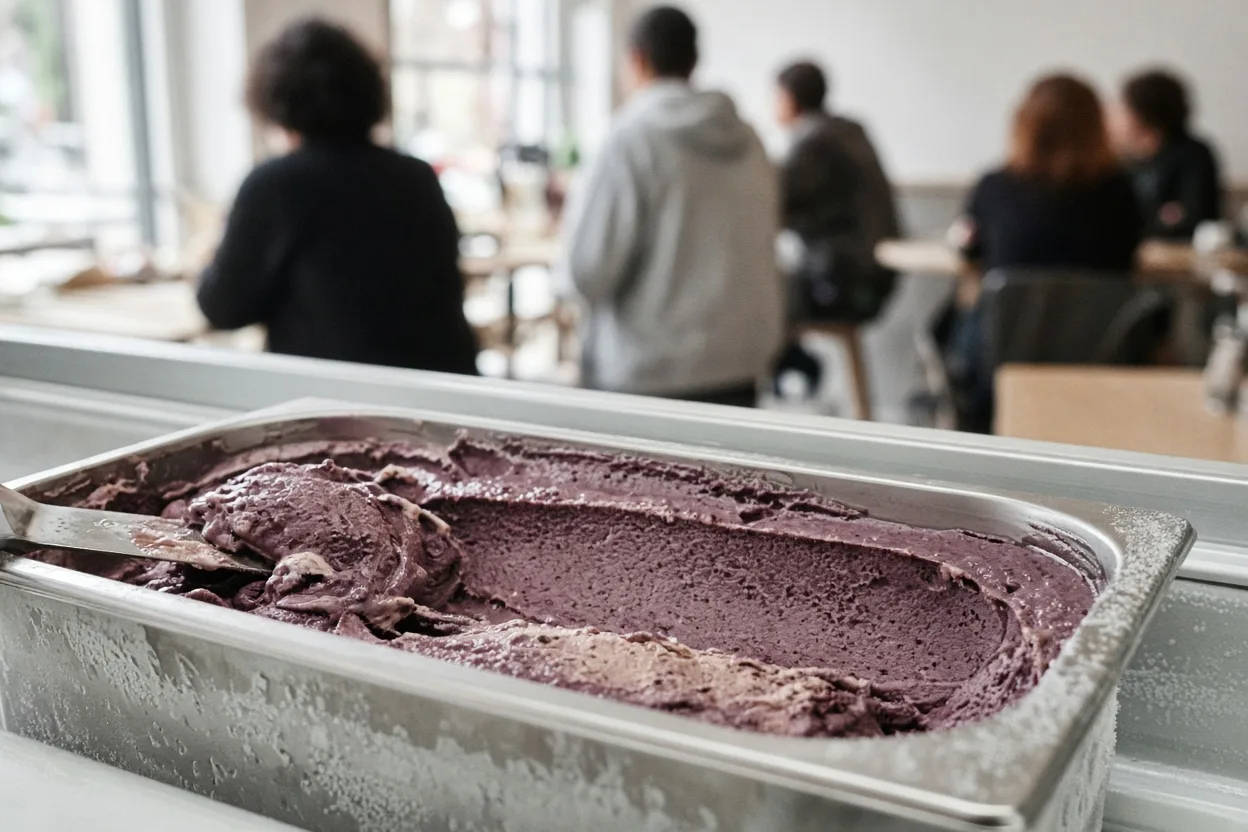
Once eleven minutes in the batch freezer have elapsed, Ines extracts the gelato with a flat steel spatula, levelling it into a clean tin. It then moves directly into the blast freezer for two hours at −22 °C to lock in the crystal structure, before tempering at −12 °C in the front counter wells. That exact temperature is where the scoop releases its perfume without shocking the mouth. For customers taking gelato home, tubs are transferred into the −18 °C hold shelf, kept until they are collected for the walk across the bridge.
This disciplined routine requires patience from our team and our guests. Amara Okafor must inspect every crate of figs and pears, ensuring natural sugar levels match our recipes. Mei Han and Rafael Moreno manage the pace at the counter, explaining why a particular flavour may take a new churn to reappear at the slab. We believe this deliberate craft makes all the difference. When you carry a cup out along Quay Lane in the evening air, you are tasting an eleven-minute moment frozen in time.