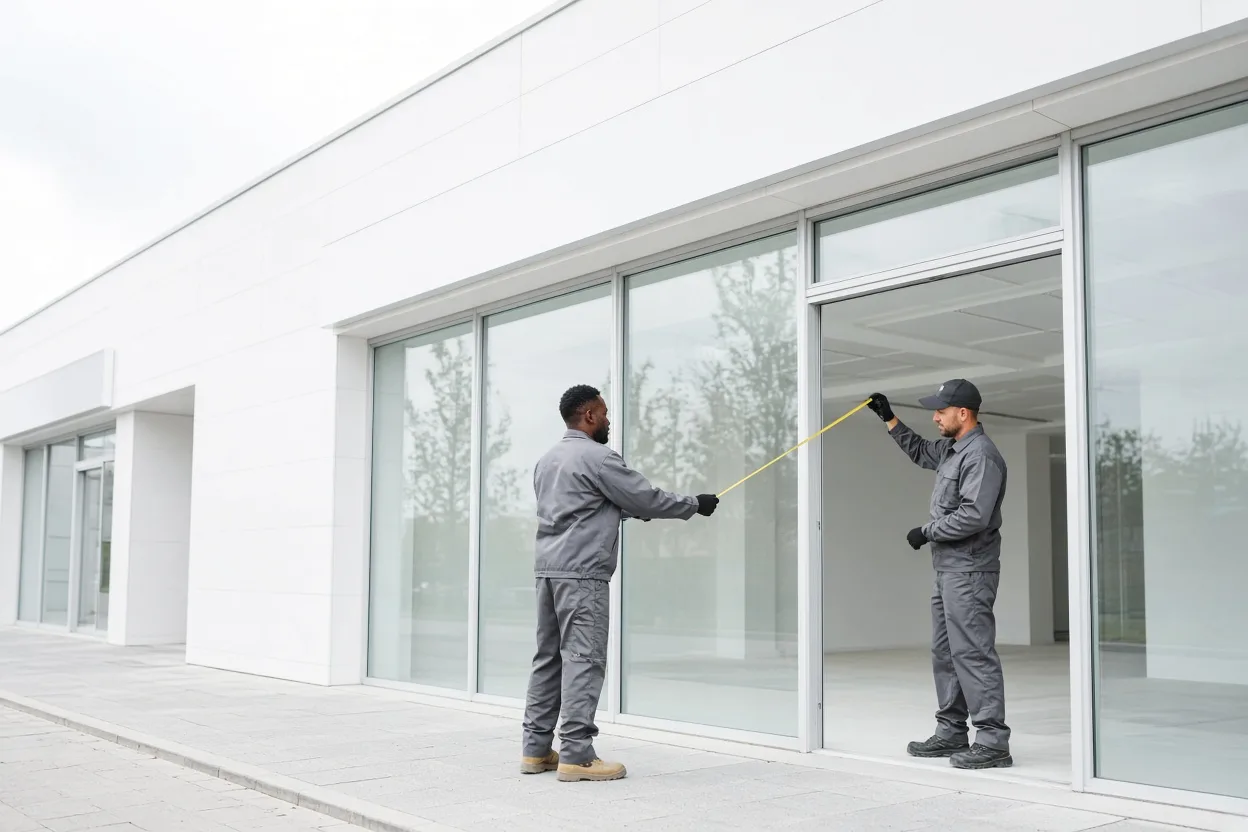
When a shopfront pane breaks on a busy commercial street in Lindenport, the immediate instinct of many property owners is to demand glass on site the following morning. That reaction is completely understandable. An open or boarded storefront harms retail footfall, lowers street visibility, and exposes stock to weather and security hazards. Yet in commercial glazing, rushing directly from an initial tape measurement to placing a glass order is the single most frequent cause of delayed handovers, rejected deliveries, and wasted expenditure.
At Fuchi Glazing, we operate under a strict, non-negotiable rule: every commercial pane is measured on two separate days. Our founder, Corin Abbott, established this procedure when setting up our workshop at Calder Yard in 2011. While working as a shopfitter, Corin witnessed two costly orders of custom architectural glass arrive on site in a single month only to be rejected because the frames had settled out of square. The panes were four millimetres too wide for the aluminium rebates. Because architectural toughened glass cannot be trimmed, ground, or altered once it emerges from the furnace, both panels had to be scrapped. The client lost two weeks waiting for replacements, while the contractor absorbed the manufacturing loss.
To eliminate that risk entirely, we separate the pricing survey from the manufacturing check measure. When a client contacts our office, we dispatch our lead surveyor for a focused 45-minute survey visit during our regular Tuesday to Thursday survey window. Using optical levels and calibrated laser meters, the surveyor records width dimensions at three separate heights and vertical drops at three points along the frame. We also verify both diagonal measurements against our strict 3 mm out-of-square tolerance. This initial visit provides the exact dimensional data and access notes required to produce a fixed, itemised quote within 3 working days.
The second measurement happens only after the client approves the written quote and confirms the project scope. On that day, our check-measure surveyor, Nadia Petrova, returns to site with a second technician to take independent readings of the aperture. This step is not a casual verification; it is a full diagnostic check. Commercial buildings settle over time. Heavy traffic, fluctuating ambient temperatures, and structural masonry loads constantly exert subtle forces on aluminium and timber window frames. Between an initial enquiry and contract approval, a timber sill may have shifted or an aluminium bead may have distorted under wind pressure.
Nadia re-verifies all six critical readings: width at top, middle, and bottom; height at both jambs and centre; corner diagonals; threshold level; rebate condition; and external access routes. If the second check reveals any movement or frame deflection, the manufacturing cutting schedule is adjusted before Ruth Okonjo places the purchase order with the glass processing plant. Once the toughened or laminated safety glass is ordered, the typical production lead time spans 8 to 12 working days. When our fitting crew, led by Joel Mensah, arrives on site with our glass-handling suction lifters, the new pane drops cleanly into the frame on the very first attempt.
Fitting right the first time allows our crews to complete most shopfront glazing in a single morning, starting at 06:30 so retail stores can reopen before peak trading begins. By taking the time to measure twice, we protect our clients from the frustration of custom glass that almost fits. In commercial glazing, precision at the frame is the only standard that truly matters.