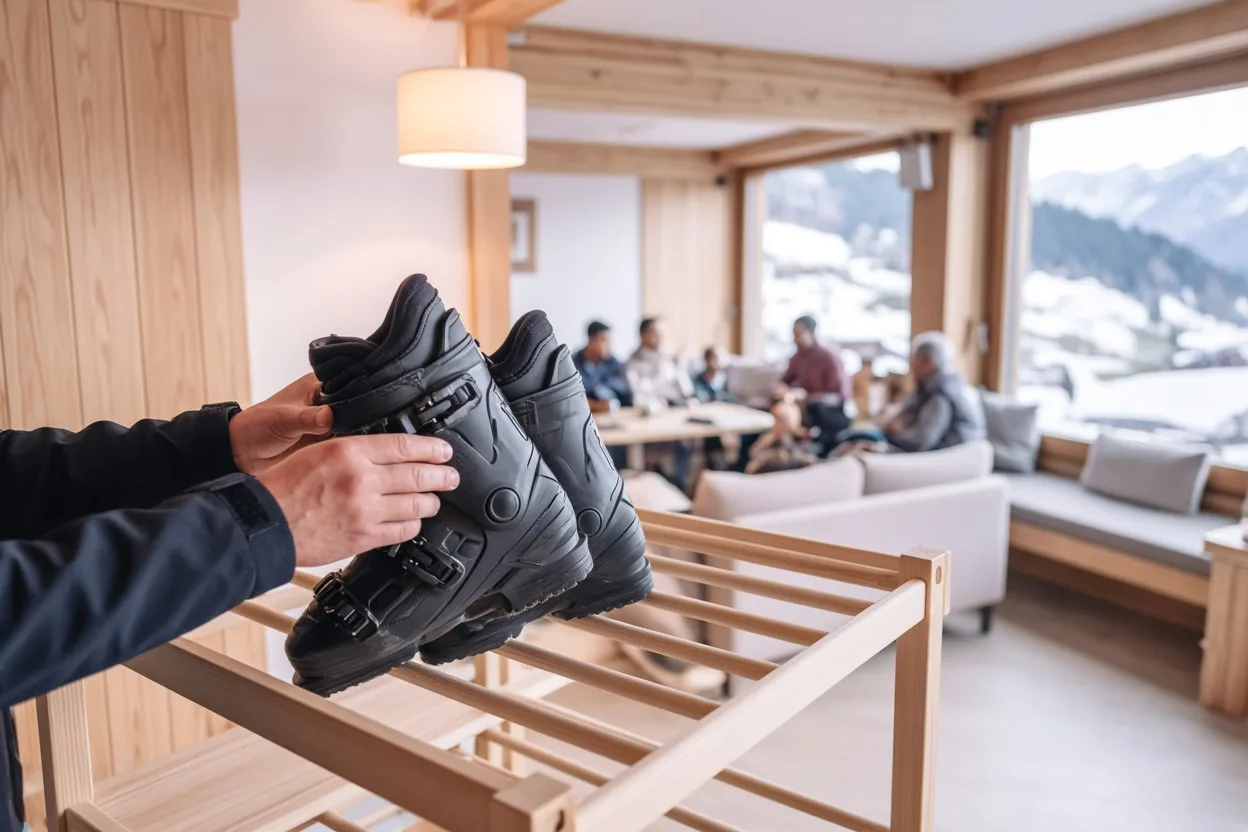
At ten o’clock each winter evening, when the last conversations in the lounge have settled and dinner service has ended, Samuel Okafor heads down the stone stairs into the drying room. Outside, snow falls quietly over Valmont-Haut at 1,480 metres elevation, burying the ski racks beside our front door. Inside the drying room, the air is already warm and circulating. Built in 2013 to replace the modest ski rack Anna Brenner and Luc Morel used when the chalet first opened with eleven rooms in 2009, this space was engineered specifically to solve the single most persistent challenge of an alpine winter: damp ski boots.
With eighteen guest rooms in the chalet today, the room handles dozens of boots, gloves, helmets, and jackets every single night of our winter season between 5 December and 12 April. Each guest is assigned a dedicated numbered bay when they arrive and collect their room keys and lift passes from Mei Lin Tan at reception. Samuel walks the rows systematically at 22:00, checking that every boot is mounted correctly onto the heated aluminium uprights. These vertical tubes channel warm, dry air directly into the toe box and heel pocket, allowing trapped moisture from a full day on the slopes to evaporate without baking or stiffening custom moulded boot liners.
Skiing from our door across the 64 kilometres of pistes and 14 lifts of the Valmont-Haut domain means gear works hard. The main gondola station sits only 90 metres away, and guests often spend seven or eight hours on the mountain before skiing directly back to our threshold. By midday, when hot soup is served in the boot room at 12:30 and tea and fresh cake appear beside the fireplace at 16:00, outer shells and gloves are damp with cold snow. Wet gloves and thermal liners go onto secondary warm-air branches above the boot racks, where gentle low-velocity ventilation prevents technical membranes and soft leather from hardening.
The heating system operates on an automated timer calibrated to cycle through three distinct stages through the night. The first phase uses active air extraction to draw heavy moisture out into high-level exhaust ducts while the rest of the chalet sleeps. The second phase maintains a steady, moderate ambient temperature that thoroughly dries the outer plastic shells, buckles, and footbeds. The final warming phase activates shortly before dawn, gently reheating the interior liners so that when guests come down after breakfast at 07:00, their boots are not merely dry, but pleasantly warm to the touch.
By 08:45, when head ski instructor Ingrid Solheim meets her group outside on the snow, everyone is laced up, stepped into bindings, and ready to glide toward the gondola without fighting cold, stiff plastic. Sliding your foot into a warm, completely dry boot transforms the very first turn of the day. It is an unassuming, practical routine, but like Luc Morel’s four-course dinners at 19:30 or the pine logs stacked by the hearth, it represents the quiet care that defines life at Yukishiro Chalet.