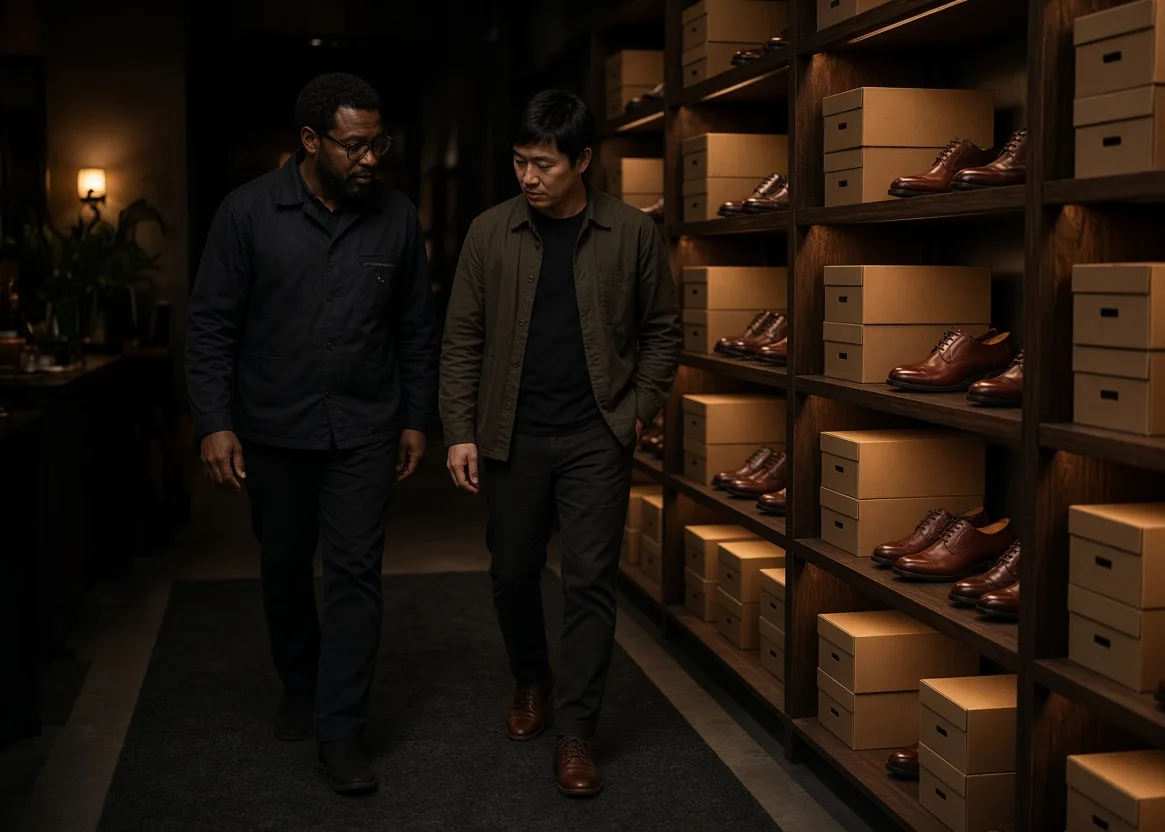
At 10:10 in every fitting we measure both feet, and we write them down as two sets of numbers. Length, width, heel, and instep. The card stays on the counter while you try a pair, and it is what we read again if you come back for a second pair or for a resole years later. Yukiki Shoes has worked this way since Mara Lindqvist opened the shop in 2011. The appointment is 45 minutes. Measuring is the second step, after you arrive at 10:00 and before you try anything at 10:20.
People often arrive with one size in mind. It is the size printed in a pair they already own, usually the shoes they wear most, which we do ask you to bring. That number is a clue. It is not a measurement of the foot that will stand on our stool today, in the socks you usually wear. Socks change the fit. So does the last. A size that felt right in a soft shoe can sit short on the Arden oxford, or long on the Wren loafer. We would rather spend the minutes at 10:10 than discover the difference at 10:35, halfway down the shop floor.
The two feet are rarely identical. Sometimes the difference is small enough that one size still works. Sometimes it is a full size, or a half size, and a single pair forces one foot to compromise. We keep sizes from 35 to 47, including half sizes, so the card can name those differences precisely. When the numbers diverge, we fit split sizes. The pair we use most often for that is the Arden oxford, the round-toe standard last, at €265. A groom came in for a wedding pair with one foot larger than the other. We did not average the two feet into a middle size. We measured both, fitted the Arden in split sizes, and he walked the floor at 10:35 before anyone called it done.
The same habit matters when the feet match and the days do not. A nurse on 12-hour shifts needed a derby that would not press a wide forefoot by the end of the day. The Hollis last is cut for that forefoot, and the Hollis derby is €245. Measuring both feet still came first. A wide forefoot on one side and a narrower one on the other would have made a single wide pair a guess. She stood for the measurement in the socks she wears on shift, because a thin sock kept for best would have given us a polite, wrong card.
We also measure again when an old pair comes back. A walker brought a nine-year-old Moor Chelsea boot to the bench. The Moor last is the high-instep shape, and the boot is €290 when new. The upper still followed the foot, and the sole was finished. Ravi Mehta does a full leather resole for €85, with the pair ready in 10 working days. Before that job was accepted, we looked at both feet again. Nine years is long enough for one foot to change, and a resole on a pair that no longer matches is a careful waste of a good upper. The first stretch on a pair bought here is free. A later stretch and adjust is €20. Neither replaces the measurement.
The six lasts only help after the card exists. Arden for a standard round toe, Hollis for a wide forefoot, Wren for a narrow heel, Moor for a high instep, Fen for a soft square toe, Teal for low volume. Trying all six on an unmeasured foot would use the whole appointment and still not tell us which foot we had fitted. The clock is fixed: arrive, measure, try, walk, decide. By 10:45 you know whether the pair on the stool is the pair that should leave the shelf.
If you book, bring those usual socks and the shoes you wear most. The fee is €20, credited to any pair. The stool is at 14 Lantern Row, Halden, and there is only one of them, so the slot is yours alone for the 45 minutes.