When I founded Yuka Tiles in 2009 at Saltgate Works in Eastmere, the first decision was where to place the low comparison bench. Most commercial tile showrooms keep their surfaces enclosed deep beneath ceiling tracks of halogen spots or balanced LED downlights. That kind of lighting produces an even, predictable glow, but it also creates an illusion. Overhead electric lamps flatten the micro-texture of honed stone, soften the subtle relief of glazed ceramics, and wash out the complex pigments baked into modern porcelain. A tile installed in a home or public building will never live under sterile, static lighting; it will live with the weather, the time of day, and the shifting sun.
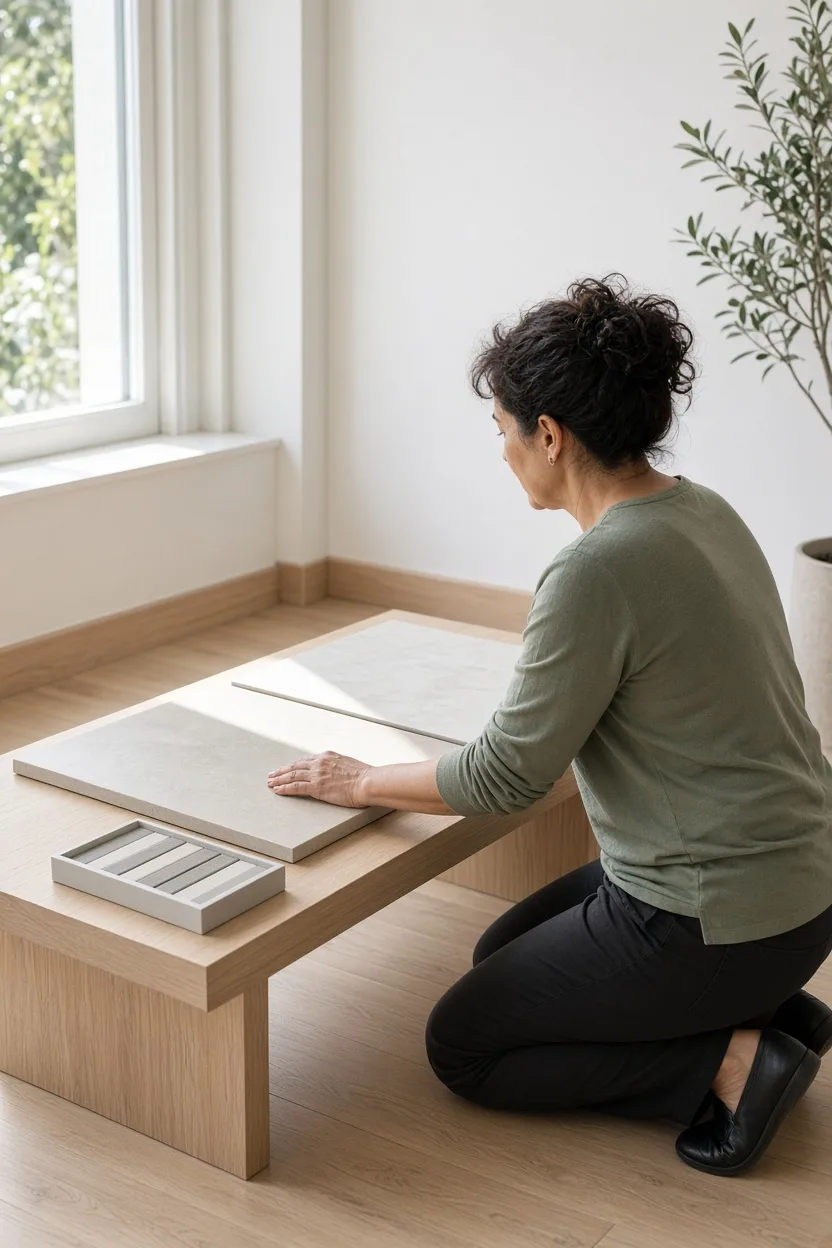
Our showroom window at Unit 3 faces south-east, looking out over 21 Weaver Street. From early morning until mid-afternoon, natural daylight moves continuously across our floor. The prime hours for material comparison run between 10:00 and 14:00, but the decisive moment occurs at approximately 13:00. That is the hour when the direct sun edge crosses the low pale-oak bench. One half of a tile rests in direct, hard raking sunlight, while the other half sits in soft, ambient shadow. At that precise boundary, you see everything: the bevelled corners, the subtle crackle glaze, the depth of quarried aggregates, and the true mineral undertones.
A porcelain slab can read warm and buttery at ten in the morning, yet shift toward a cool, quiet grey by four in the afternoon. At one o’clock, with the light striking diagonally across the face, you can turn a tile a quarter-turn and instantly see its shade variation. Whether a production batch is graded V1 for uniform tone or V3 for moderate variation, the sun edge brings the manufacturer’s code to life. When Nadia Kowalczyk was planning her kitchen floor in Eastmere, she took two separate seven-day sample loans home to test next to her timber floorboards, but she came back to the showroom for a 13:00 window appointment. She knelt beside the bench with two 120 × 120 cm warm-grey porcelain slabs and laid our tray of grout sticks between them. Seeing the sun edge cut across the rectified edges made the choice immediate and certain.
This is why our comparison bench is intentionally kept low and uncluttered. We place two large-format slabs side by side, position our 24 grout colour sticks between them, and ask clients to bring their own physical project fragments. Bring a painted timber sample, an offcut of skirting, or an actual cabinet door from your joiner. Holding your materials directly against our porcelain slabs, limestone, travertine, or handmade glazed wall tiles in the one o’clock light tells you more in two minutes than a dozen small brochures ever could.
Even after an appointment at the bench, we never encourage anyone to order immediately. We lend up to five standard samples for seven days, packed in a canvas bag with their technical specification sheets, so you can observe the materials in the morning, midday, and evening light of your own rooms. But the benchmark always begins here at Saltgate Works, watching the shadow wedge travel across the pale oak as the clock turns to one.