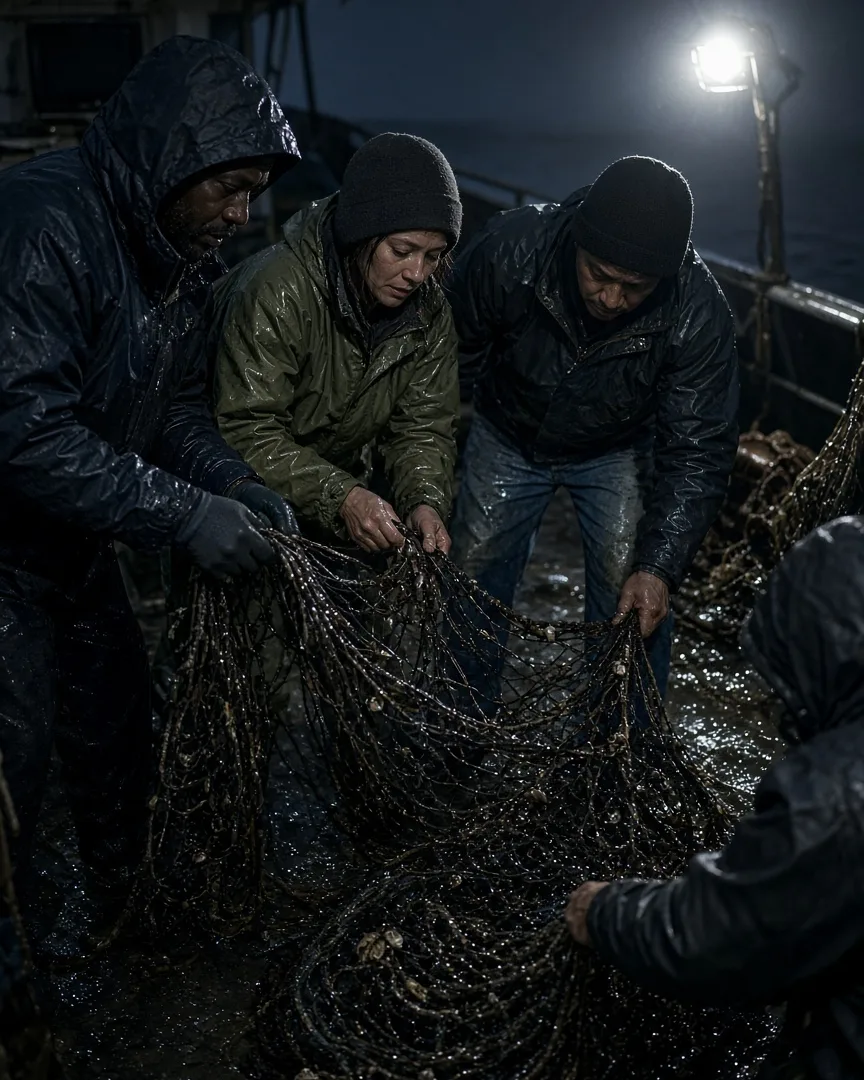
We boarded the fishing vessel Marit in early autumn, when the daylight over the harbour at Port Alder was already shrinking. My plan as director was straightforward but demanding: to stay beside the crew until our presence was no longer an event. In documentary filmmaking, access is not an administrative hurdle to be cleared with a signed piece of paper; it is a daily habit of quiet attention. For the first two months, the camera stayed inside its case for most of every watch. Cinematographer Adaeze Morrow and I spent those early trips simply learning where to stand without getting in the way of heavy winches, slick nylon warps, and swinging trawl doors.
By winter, the crew had stopped glancing at the lens. When you spend fourteen months living alongside fishermen, the artificial barrier between the film crew and the working deck dissolves under the sheer weight of shared routine. On deck, sound recordist Luca Ferreira worked under a wet-weather hood, securing microphones against freezing spray and gale-force wind. We worked entirely with available light, using the single halogen work lamp mounted above the wheelhouse steel door as our primary key. In that harsh, directional beam, the physical texture of wet oilskins, rusted winches, and cold ocean spray revealed the true nature of the work far more honestly than any cinematic lighting kit ever could.
The film that eventually became The Rope Keepers was shaped in those unprompted, quiet moments between hauls. I remember one dawn watch particularly well: standing in the open doorway of the wheelhouse holding our compact cinema camera at chest height, half-shielded from the driving rain, watching a senior deckhand methodically coiling thick mooring rope on the forward deck. He had done that motion thousands of times over thirty years at sea. Nobody spoke; the only sounds were the thrum of the diesel engine, the rhythmic hiss of water through the scuppers, and the low crackle of the wheelhouse radio. That single dawn scene became the visual anchor of our entire film.
Back at Studio 3 in Port Alder, editor Hana Sørlie and I spent sixteen weeks cutting seventy-two minutes of film from nearly two hundred hours of observational footage. We resisted the temptation to invent artificial drama through rapid cutting or dramatic musical scores. Instead, we let the real duration of maritime labour dictate the editorial rhythm. When a haul takes twenty minutes to clear, the film allows the viewer to feel the passage of that time. Later, colourist Owen Achterberg preserved the natural desaturation of coastal daylight and dark sea waters during final grading.
When The Rope Keepers screened at Northsea Documentary Days in 2025, several crew members from the Marit travelled down to attend the festival premiere. Sitting in the dark cinema beside the men whose daily lives we had recorded was the real test of our practice. When the lights came up, they remarked that the film felt exactly like being on watch in mid-November: cold, quiet, demanding, and true. That response confirmed what Utsushi Films has practiced since 2013: if you stay long enough and listen with disciplined patience, the reality of people’s lives will always be more powerful than anything you could script.