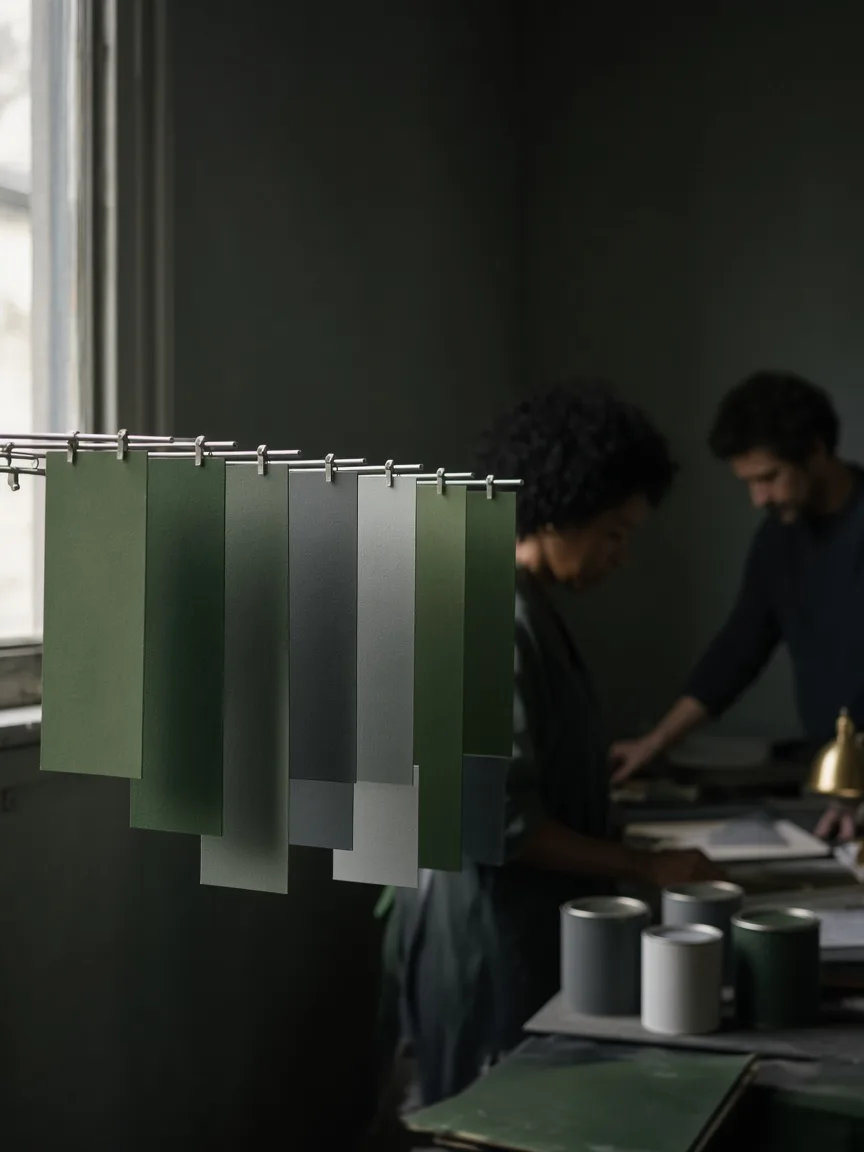
When a customer steps up to the mixing counter at Verfstraat 18 with a paint flake, a torn piece of linen, or a photo on their phone, the instinct is often to rush. People want to see the colourant drop from the tinting machine nozzle, watch the canister shake, and leave immediately with a fresh tin under their arm. But at Toso Paints, we never hand across a freshly mixed colour without painting a drawdown card first. And once that card is painted, we place it on a drying rack by the window and wait twenty minutes.
The reason is grounded in the basic physics of paint emulsion. Wet paint reflects surface glare. The water content creates an artificial sheen that scatters overhead shop light, making any wet pigment appear lighter and more milky than it will look once cured on a wall. If Lena Brandt were to read the wet formula and declare the match complete, the resulting room would almost certainly turn out darker, heavier, or colder than expected. House Matt, our washable flat emulsion, undergoes a marked shift as its water evaporates, settling into its true velvety depth. Our Wood & Metal Eggshell and mineral Lime Wash behave similarly, revealing their genuine undertones only after the liquid vehicle has cleared.
Those twenty minutes of waiting are where the actual craft happens. Lena draws a measured layer of paint across a rigid test card using a steel drawdown bar, producing a clean, uniform film of consistent thickness. The card goes onto a slim rack positioned beside our tall, north-facing workshop window. We never evaluate colour under fluorescent tubes or warm shop spotlights. Retail bulbs distort chromatic balance, hiding green undertones beneath amber warmth or deadening subtle greys. Daylight from a Dutch sky is honest, diffuse, and steady.
We saw this principle clearly in a recent consultation for a north kitchen in Kralingen. The homeowner arrived with a phone photo showing an old olive green wall. After Lena formulated the initial recipe and mixed a 100 ml sample pot, the wet paint looked convincingly close on the stirring stick. But when the drawdown card dried twenty minutes later beside the window, the cool northern daylight revealed that the green had leaned too sharp and acidic for a Rotterdam kitchen. Standing together at the counter, Ines Valk and the customer agreed to adjust the recipe one step warmer. Lena altered the tinting formula, logged the adjustment in our permanent archive, and mixed the revised 2.5 L tin of House Matt. The finished room in Kralingen captured the calm warmth the owners wanted because the colour was judged dry, against natural light.
On Saturdays, this same patient testing extends to our swatch table between 10:00 and 13:00. Mei Lindgren sets out sample boards, brushes, and pots for visitors who want to compare shades side by side before ordering. Decorators and neighbours sit together, applying coats of Lime Wash or Wood & Metal Eggshell, watching the pigments dry under changing Rotterdam cloud cover. There is no guesswork involved, and no hurried decisions made under artificial lamps. Every recipe number is recorded on the lid and filed away, so when an extra tin is needed later, the exact tone can be reproduced without variation.
This methodical step forms the core of our shop philosophy: a colour is chosen against the room, not the chip. Whether you bring in a sample of wallpaper, an architectural tile, or a flake of plaster, twenty minutes by the window ensures that what leaves our counter in a tin matches the reality of your living space.