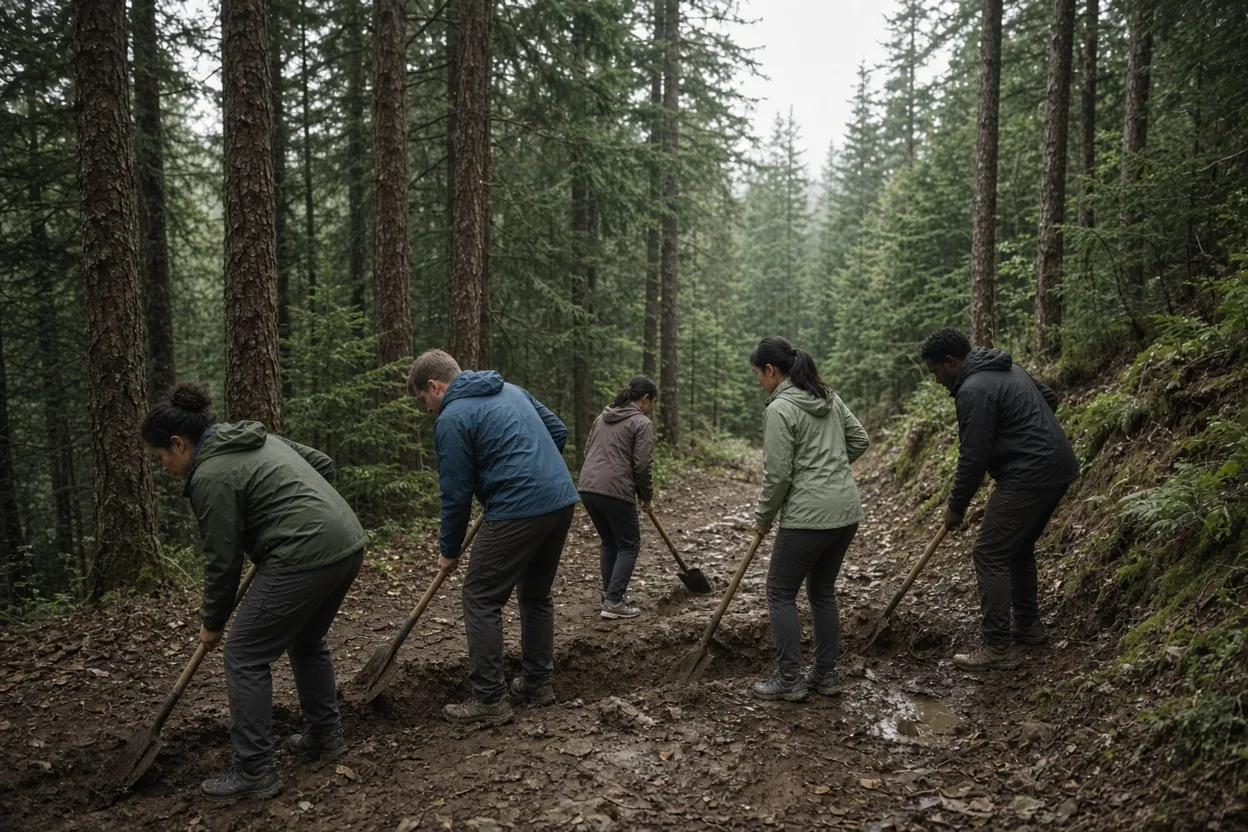
At first light, mist still sat heavy across Hollin Village meadow. Inside Hollin Village Hall on Mill Lane, forty-six volunteers gathered around wooden trestle tables for hot tea and a briefing from Elise Duval, our trail stewardship lead. Outside, spades, iron rakes, and mattocks leaned against the timber wall. The objective for the day was straightforward but demanding: repair winter erosion and open three hundred and eighty metres of stone drainage channels along the upper beech ridge before the ground dried and compacted.
Since the Sanroku Trail Series was founded in 2014, our philosophy has remained unchanged: we borrow the mountain paths for a single day, and we leave nature as it is. But leaving nature as it is in an alpine valley requires active care. Heavy winter snowmelt and unseasonal rains wash loose shale into the natural gullies, forcing running water onto the walking tread. Over months, footsteps turn wet soil into deep ruts, widening the path into fragile bilberry heath. Tobias Wren, our course setter, had surveyed the route following the thaw and mapped critical erosion zones between Beech Saddle and the upper ridge.
By mid-morning, the work parties had hiked up through the bare beech woods to their designated sectors. Working in small teams, volunteers cleared mud, lifted heavy river stones, and rebuilt angled cross-drains designed to steer surface runoff safely off the path and into the leaf litter below. Maren Kosta, our race director, worked alongside local valley residents and runners who had travelled from nearby towns for the weekend. Many in the group had already entered Snowmelt 21 and Beech Line 32, while others were preparing for the late-summer ascents of Gorge 45 and Autumn Ridge 60.
Trail stewardship is physically exhausting work, but it changes how a runner understands the ground. When you spend hours hauling granite slabs to line a culvert, you never view a mountain descent the same way again. Every stone placed by hand protects the root system of a mature beech tree and keeps the soil intact beneath hundreds of passing trail shoes. By early afternoon, the teams had cleared blocked conduits and reconstructed continuous stone runnels spanning exactly 380 m of degraded trail.
Dr Samir Haddad, our medical lead, also inspected access points along the route during the afternoon, checking track gates and radio reception with Hollin Village Hall. Safety on race day begins weeks before any starting horn sounds, and clear, stable footing is the most effective injury prevention we can offer our runners. When trails are neglected, ankle sprains and slips on mud multiply rapidly. By investing communal effort into stone drainage and path stability early in the year, we ensure that both our runners and valley hikers can travel the ridge securely throughout the season.
When the final tools were loaded back into the hall at the end of the shift, the ridge was quiet again. Under our series policy, every volunteer who works a trail shift receives a complimentary race entry to a later event in the season, coordinated by Lucía Ferro at the entries desk. Yet for the forty-six volunteers who stood together scraping mud from their work boots, the true reward was already evident on the mountain above: clean water running through stone channels, and a path prepared to withstand another season of mountain running without leaving a scar.