At eight-thirty on a Saturday morning, the lobby of Okami House at Rua do Farol 22 in Lisbon is already active. While hotel guests finish their breakfast and prepare for morning departures, a small group of prospective students gathers near the reception desk. These applicants are here for the Saturday shift trial, the second step in our admissions process for the Two-year Diploma in Hotel Operations. Rather than relying on standard entrance tests or passive interviews, Okami College asks each candidate to spend three hours working directly on an operational floor beside an enrolled student.
Sofia Andersen, our admissions officer, greets the candidates in the front lounge and distributes crisp navy aprons. The trial is not an examination of prior technical skill; indeed, most applicants arrive with no hospitality background whatsoever. Instead, the morning is designed to test temperament, curiosity, and comfort in a service setting. After a ten-minute briefing outlining the safety guidelines and floor etiquette of Okami House, each applicant is paired with a current student and assigned to one of our active stations: the front desk, the banquet room, or the rooms division.
Candidates assigned to the front office join instructor Tomás Ribeiro and his Term 1 desk group. Here, the applicant stands beside a first-year student handling morning check-outs for our forty-two guest rooms. The candidate watches how reservation folios are verified on the screen, listens to the phrasing used when asking departing guests about their stay, and helps organize key cards for afternoon arrivals. When a phone call arrives at the reception desk, the applicant observes how reservations are entered into the system. Within twenty minutes, the initial nervous hesitation gives way to the rhythmic coordination of hotel desk operations.
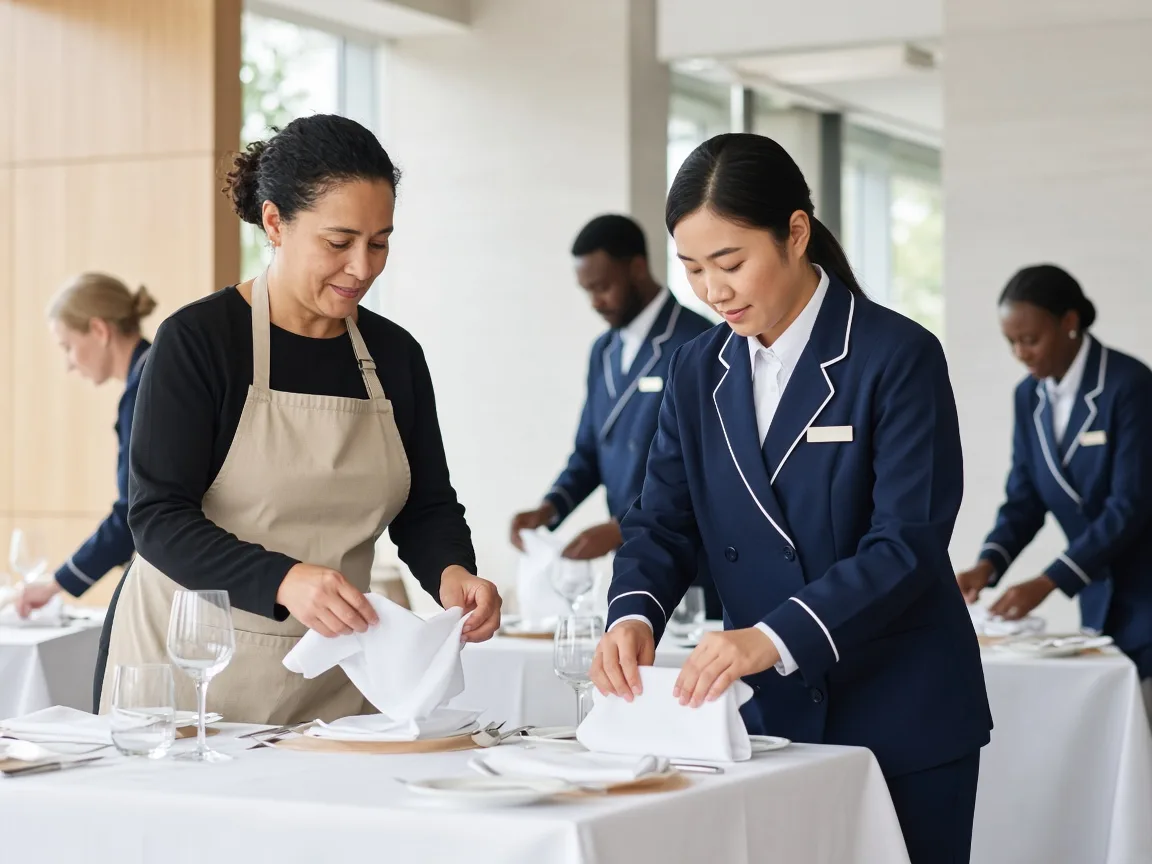
Down the hall in the dining room, candidates assigned to banquet operations work under the eye of instructor Amara Okonkwo. With sixty covers scheduled for the upcoming restaurant lunch service, the room requires precise preparation. The applicant works alongside a student to align dining tables, check tablecloth drops, and place polished cutlery according to measured millimeter standards. Students explain why water glasses must sit precisely above dinner knives and how banquet service requires constant peripheral awareness. Working side by side, candidate and student fold napkins, double-check table settings, and prepare service trays for the midday service.
Upstairs in the rooms division, applicants join instructor Lin Hsiao-wen to observe how guest rooms are serviced before the noon check-in deadline. Candidates learn the discipline behind hospital corners on crisp linen, the systematic inspection of bathroom supplies, and the coordination required between housekeeping and reception. Throughout every department, instructors observe how candidates handle unexpected tasks, whether they ask thoughtful questions, and how naturally they communicate with colleagues and guests.
At half past eleven, the three-hour shift concludes. Candidates return their aprons and assemble in the faculty library for a thirty-minute conversation with two instructors. Having just completed three hours on the floor, the discussion is grounded in tangible experience rather than hypothetical scenarios. Candidates talk about what surprised them, what felt challenging, and why they want to dedicate two years to mastering hotel operations. Within ten working days, formal offer letters are dispatched, inviting accepted candidates to confirm their place with the €900 deposit within twenty-one days. For those who join our September cohort of forty-eight students, this first Saturday morning on the floor is the foundation of their hospitality career.