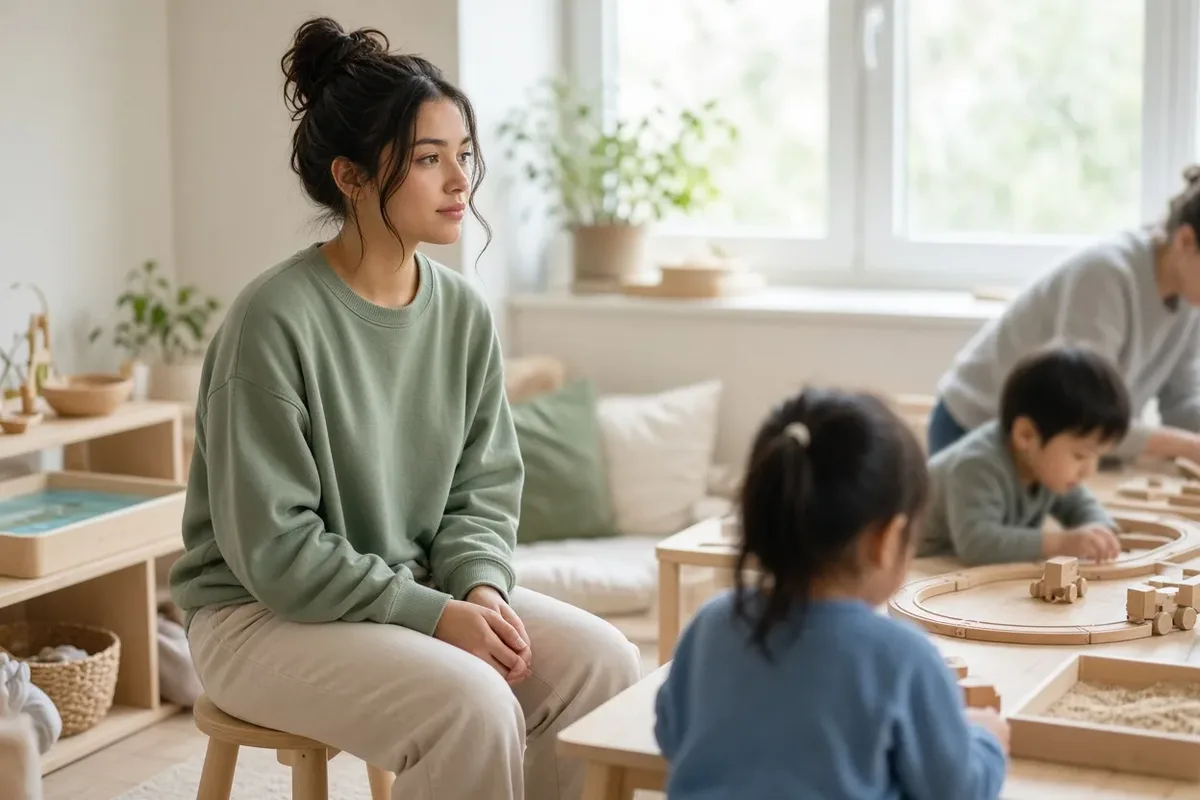
On a cool Tuesday morning at 10:40, the trainees from Mebuki College stand under the wet oak canopy at Fernhill Forest Nursery. Rain fell earlier in the morning, leaving the woodland mud kitchen thick with dark clay, pine needles, and puddles of brown rainwater. Three four-year-old children are kneeling on a wide log, busily collecting water in battered aluminium saucepans and tipping it into an old enamel baking tray. As the trainees gather, notebooks in hand, studio tutor Owen Gallagher raises a quiet hand. His instruction is simple, familiar, and always demanding: say nothing for ten minutes, take two steps back, and only watch what the children do.
In early-childhood training, the urge to intervene is nearly irresistible. New educators often believe their worth is measured by how quickly they explain a process, offer a toy, or resolve a minor hesitation. When a child balances a heavy pot along a slippery wet log, adult instinct leans forward to steady it. When another child spills scooped mud across their boots, an adult instinctively reaches for a cloth. Yet for ten minutes at Fernhill, Owen insists on silence. The trainees stand quietly with hands in their coat pockets or pencils poised over paper. Without adult interruption, the rhythm of the woodland changes. The children do not look up for approval or direction; they listen to the water splashing into the pans and negotiate their shared work.
What emerges during those ten silent minutes is a lesson in concentration and shared purpose. One boy with curly dark hair tests how much wet sand a cracked wooden spoon can support before the sand slides off. A girl beside him watches his trials three times before finding a broader pine bark strip that carries twice as much material without spilling. No teacher intervened with advice, yet physics and trial were studied closely. When two children both reach for the same tin scoop, they pause, eye the tool, and quietly agree to take turns filling their buckets. By holding back, the adult gives children space to develop their own attention, vocabulary, and social understanding.
At 10:50, Owen gestures for the trainees to step back toward the wooden benches near the fire pit. Opening their notebooks, they begin to talk through what they witnessed. Leah, a first-year Diploma trainee, notices how the children’s posture adjusted as the weight of the water changed. Practice tutor Ines Adeyemi notes the sequence of spoken cues the children used to coordinate their play. This quiet exercise illustrates the foundation of the Mebuki College method. Since Margit Sorensen gathered our first students in 1987, we have taught that educators must first become skilled observers before they can become effective guides. Across our 14 partner nurseries and reception classes in the Calder Downs, trainees learn that attentive looking is the most respectful tool an early-years teacher possesses.
Later that afternoon, the group returns to 2 Orchard Row in Hollins for their regular studio workshop, testing water trays, clay consistency, and wooden tools with Rafael Ortega and Owen. The observations written in the mud kitchen at Fernhill are transcribed into reflective journals in the library. This continuous movement between the morning floor and afternoon analysis shapes our Diploma, Graduate Certificate, and Weekend Route courses. To teach young children well, an educator must first learn to stand still, watch with care, and understand how learning unfolds when adults provide space for independent discovery.