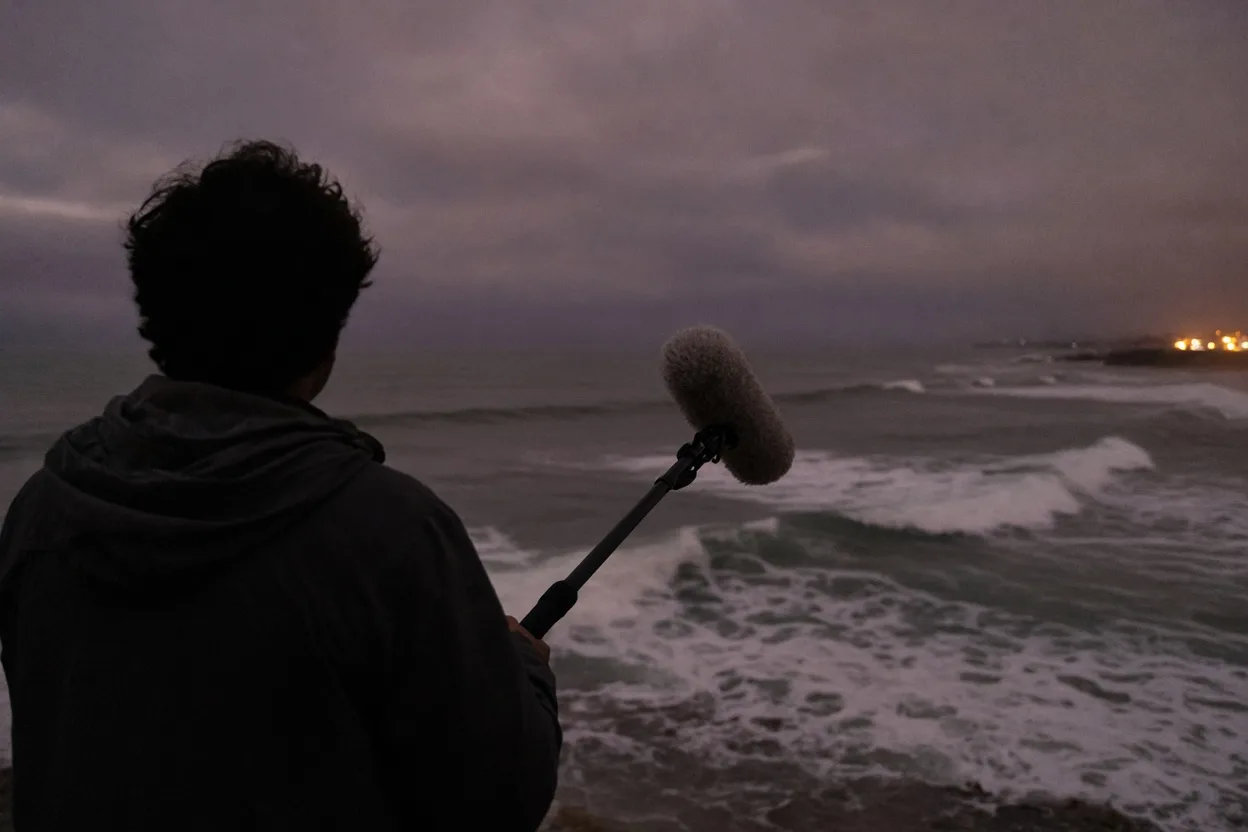
When Kodama Sound began in 2015, it started not at a piano or an orchestral template, but on a wooden quay in a fishing harbour at night. Ines Valk had taken a portable field recorder and a pair of microphones to record the water lapping against hulls, the distant clinking of mooring cables, and cold wind across wet stone for a friend’s short film. Listening back on headphones in the quiet of midnight, it became obvious that the acoustic texture of that harbour already held the emotional weight of the scene. The score did not need to invent an atmosphere from nothing; it needed to listen to the world that was already there and respond to it.
Eleven years and 64 projects later, that working method remains the central discipline of our studio at 14 Kiln Yard in Halden Bay. Before composing thematic cues or choosing instrumentation, our recordists travel to the physical environments of the story. Whether lowering a hydrophone into still lake water at 05:10, placing a stereo pair among wet pines at 23:30, or standing on tidal flats at 02:40 for nine consecutive nights, we record at 96 kHz to capture the subtle frequency spectrum of the location. These passes become the acoustic bedrock of the production.
Most dramatic scoring begins with harmonic ideas in an isolated room, with environmental ambience added as an afterthought during final mixing. That division often creates a subtle disconnection: the orchestral strings sound pristine and detached, while the background effects feel glued beneath them. By recording first, we invert that hierarchy. When we sit down at our upright piano or sketch cues with pencil and paper, the field recordings are already loaded onto the faders. We play directly against the low hum of the tidal wind, the rhythm of rain on a tin roof, or the brittle resonance of ice cracking under contact microphones at minus eleven degrees Celsius.
This approach directly shapes how melodic lines are voiced. A dense cello line that sounds rich in isolation may clash with the low rumble of coastal surf, while a delicate high-register motif might disappear entirely beneath canopy rain. When the field recording is treated as a foundational instrument, the score naturally finds the open frequency pockets. The composer writes around the existing acoustic space rather than fighting it. The resulting cues do not compete with dialogue or atmospheric sound design; they fit together because they grew out of the same physical reality.
Back at 14 Kiln Yard, this field material transitions seamlessly into our 7.1 mix stage and our four-surface foley pit. Because field recordist Jonas Berg, foley artist Amara Osei, and re-recording mixer Tomás Reyes work in the same rooms where the score is developed, there is no handoff barrier between music and sound effects. A footstep tracked on our gravel tray is tuned to match the outdoor location pass, and dialogue editor Priya Natarajan cleans production speech knowing exactly where the musical cues will enter.
Today, our library contains over 3,200 catalogued location recordings, each marked by place, hour, and microphone configuration. Yet we do not treat them as a static catalogue to be reused casually. Every film and game project demands its own physical acoustic survey. Taking a field kit into the cold before dawn requires patience and quiet attention, but it grounds everything that follows. We record the world before we score it, because the world always provides the truest starting point.