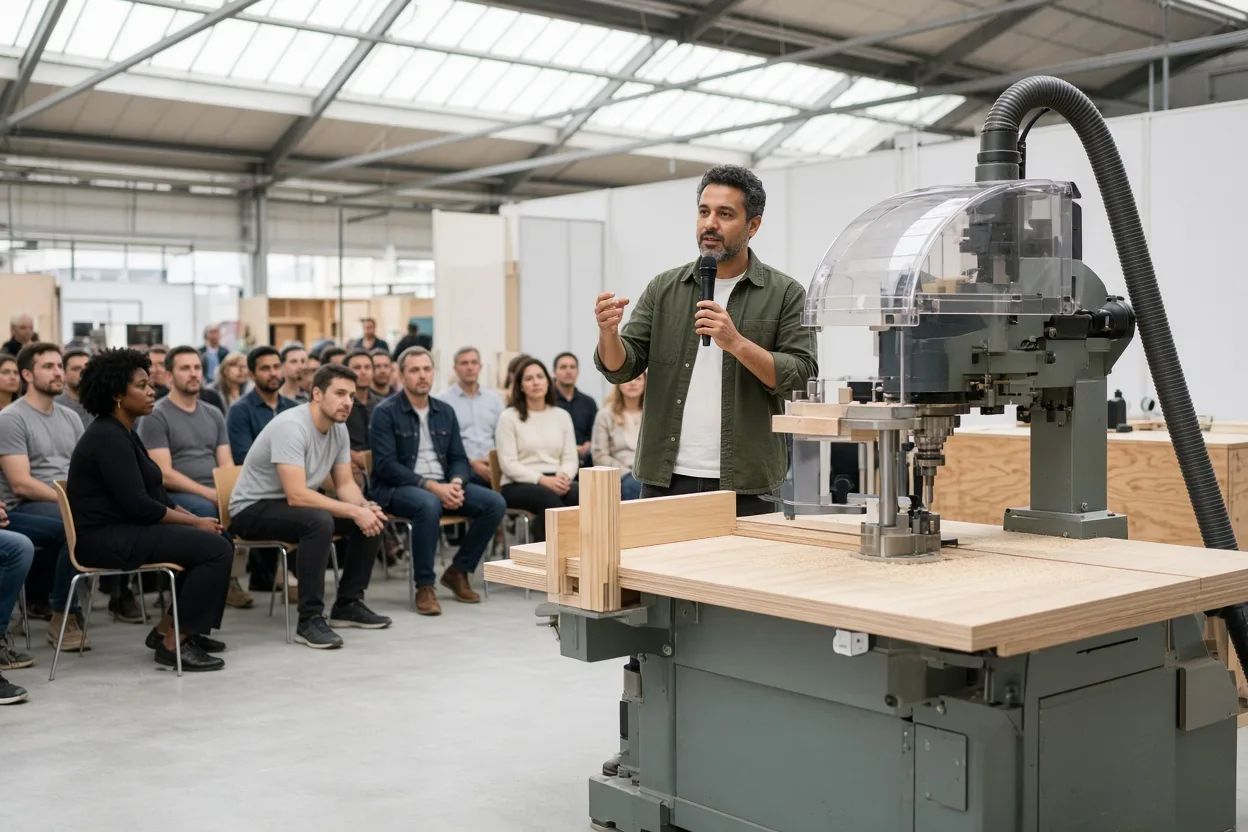
On the second afternoon of Kikai Fair 2025, Rafael Ortega stood beside stand A-14 in Zone A with a stack of birch plywood panels and a digital cutting schedule. Ortega, an independent CNC router maker, had not prepared a canned marketing presentation. Instead, six different commercial joinery owners had arrived at his stand with identical nesting parameters from their own production shops. Over the course of four hours, Ortega loaded and processed the same nesting file six times, allowing each visiting workshop manager to inspect dimensional accuracy, edge finish, and cycle time under realistic operating conditions.
This deliberate, repeatable trial captured the exact operational philosophy that Fair Director Mira Halvorsen established when Kikai Fair was founded in 2011. In an industry where machinery investments determine workshop profitability for decades, static displays and glossy specification sheets cannot substitute for the sound and feel of a machine running under load. Inside Hall 4 at the Riverside Exhibition Centre in Lindmark, visitors do not simply view machinery housings; they watch cutterheads engage timber, listen to spindle bearings under torque, and measure the cleanliness of the finished kerf.
Throughout the afternoon trials at stand A-14, safety standards established by Kwame Asante governed every movement. Observers stood behind the yellow barrier lines, ear defenders securely fitted, while the overhead dust extraction unit cleared chips immediately from the router bed. By keeping the surrounding aisles completely clear of sawdust, Ortega demonstrated that high-speed panel nesting could function cleanly without compromising adjacent stands. For the visiting buyers, seeing how the extraction hood integrated with the router was just as critical as measuring the cutting speed.
Similar practical comparisons occurred across all four floor sectors. Over in Zone B, kitchen-cabinet workshop owner Priya Nair spent her afternoon moving between three competing edgebanding stations. Having evaluated the machines on paper for months, Nair tested sample panels at each stand, inspecting glue lines, corner rounding units, and scraping stations before finally signing a purchase order. Meanwhile in Zone D, joinery teacher Jonas Lindqvist walked the extraction and tooling aisles accompanied by twelve apprentices carrying a calibrated dust meter, recording real-time air quality readings across various filtration ducting designs.
This rigorous focus on live machinery under power will expand during Kikai Fair 2027, which marks the 9th edition of the biennial fair from Tuesday 9 March to Thursday 11 March 2027. Across 22,000 square metres of hall space, 180 exhibitors will operate 62 machines under full electrical power. Tomás Ferreira is currently coordinating stand allocations across the four technical zones, while Demo Stage host Lena Vogt prepares thirty-minute demonstration blocks for live cutting presentations.
For workshop managers, joiners, and manufacturing engineers planning their visit, advance preparation remains essential. Online pass requests close on Sunday 21 February 2027, with visitor services lead Aiyana Brooks ensuring QR passes reach approved applicants within two working days. Whether your workshop needs to benchmark a nested-based CNC router, verify glue line quality on an edgebander, or upgrade dust extraction, Kikai Fair 2027 offers three focused days where machines run and buyers listen.