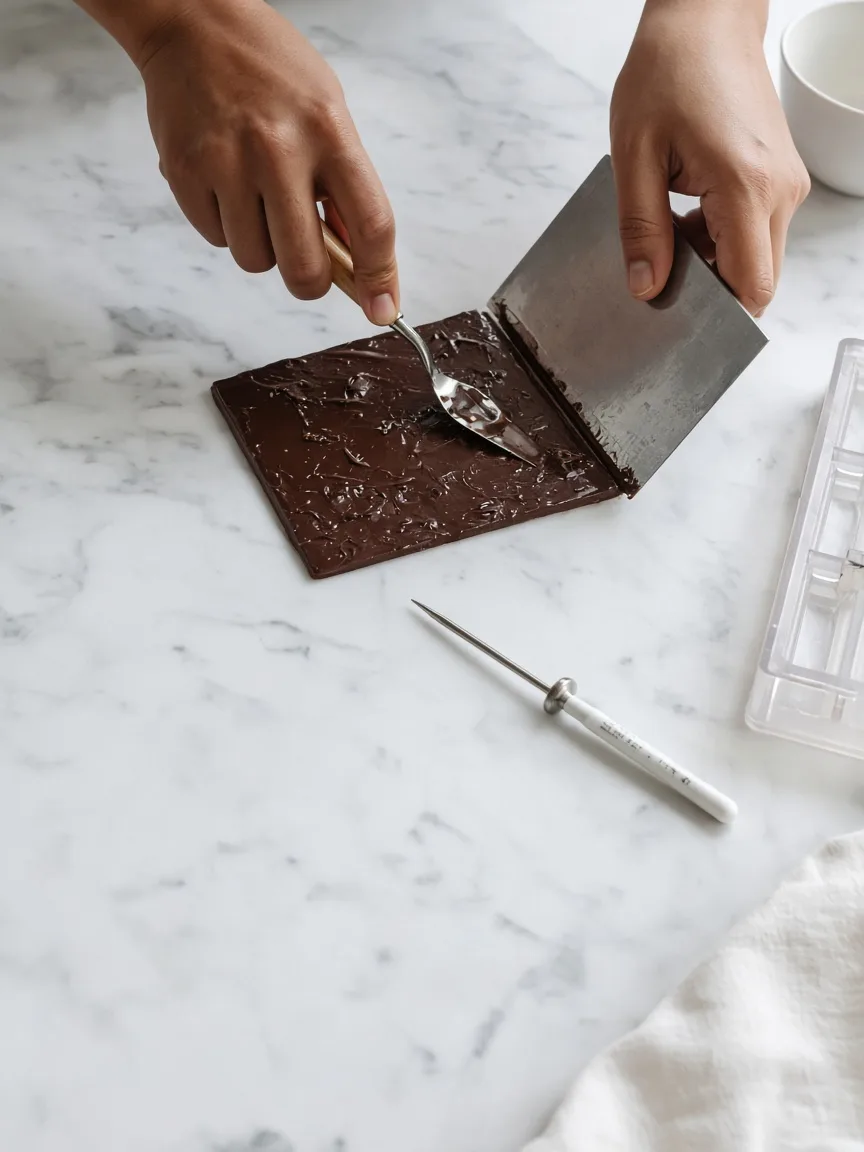
Every morning at ten, the shop smells entirely different from how it did two hours earlier. At eight, Tomás Rivera roasts and cracks the beans in the back, filling the arcade with the warm, nutty scent of toasted husks and nibs. By nine, our doors open and the first pot of drinking cocoa begins to simmer on the stove. But ten o’clock is the true turning point of our working day. That is the moment I bring warm liquid chocolate out from the melter and pour it across our marble slab, four metres behind the front counter.
Tempering is the physical process of aligning cocoa butter crystals into stable form. Melted chocolate at forty-five degrees Celsius is fluid, glossy, and completely unstructured. If left to cool on its own in a bowl, it would solidify into a dull, greyish mass with a crumbly texture and uneven streaks of separated fat. To give chocolate its clean snap, satin gloss, and melt-in-the-mouth texture, we must coax the cocoa butter into crystal form five. Doing this by hand on a cold stone slab remains the most responsive, sensitive method known to chocolatiers.
I work the chocolate across the stone using a wide palette knife and a flexible steel scraper, drawing ribbons back and forth until the stone draws away the heat. As the temperature drops toward twenty-seven degrees, the chocolate thickens noticeably under the blade, resisting the steel with a gentle pull. Then, working quickly, I push the mass back into the warm bowl to raise the temperature slightly to thirty-one degrees. You can tell when the temper is true not just by reading the probe thermometer, but by the clean gloss on the blade and the sudden release of deep, complex floral and fruity notes into the room.
This season, we are working with beans from five distinct growers: Alto Sereno, Río Claro Growers, Monte Ceiba, Bahía Verde, and Ridgeway Estate. Each origin behaves differently on the marble. Monte Ceiba cools slowly and yields deep cocoa depth, while Bahía Verde crystallises with quick agility and releases lighter, wine-like fruit tones the second the palette knife spreads it thin. Working by hand allows us to feel the subtle variations in cocoa butter content and viscosity that mechanical continuous tempering machines inevitably miss.
Timing the temper at ten sets the cadence for everything that follows. By noon, Lukas Brenner is ready to fill and tap the polycarbonate moulds for our single-origin bars and delicate bonbon shells. By one in the afternoon, Priya Raman can slice the morning’s hardened slabs at the counter to serve today’s first tasting flights alongside hot cocoa. And by three, Adaeze Okafor draws upon the tempered couverture to glaze the cakes Sofia Marchetti will box for tomorrow’s collections.
Chocolate is a living, changing substance, and it is at its absolute best within hours of being tempered. The snap is crisper, the surface has an unbroken mirror sheen, and the volatile aromas have not yet faded into the packaging. When you visit our shop at 14 Linden Arcade in Harrowfield, you do not simply purchase chocolate made days or weeks ago in an unseen factory. You sit four metres away from the stone where it was tabled this morning, tasting the exact craft of the day.