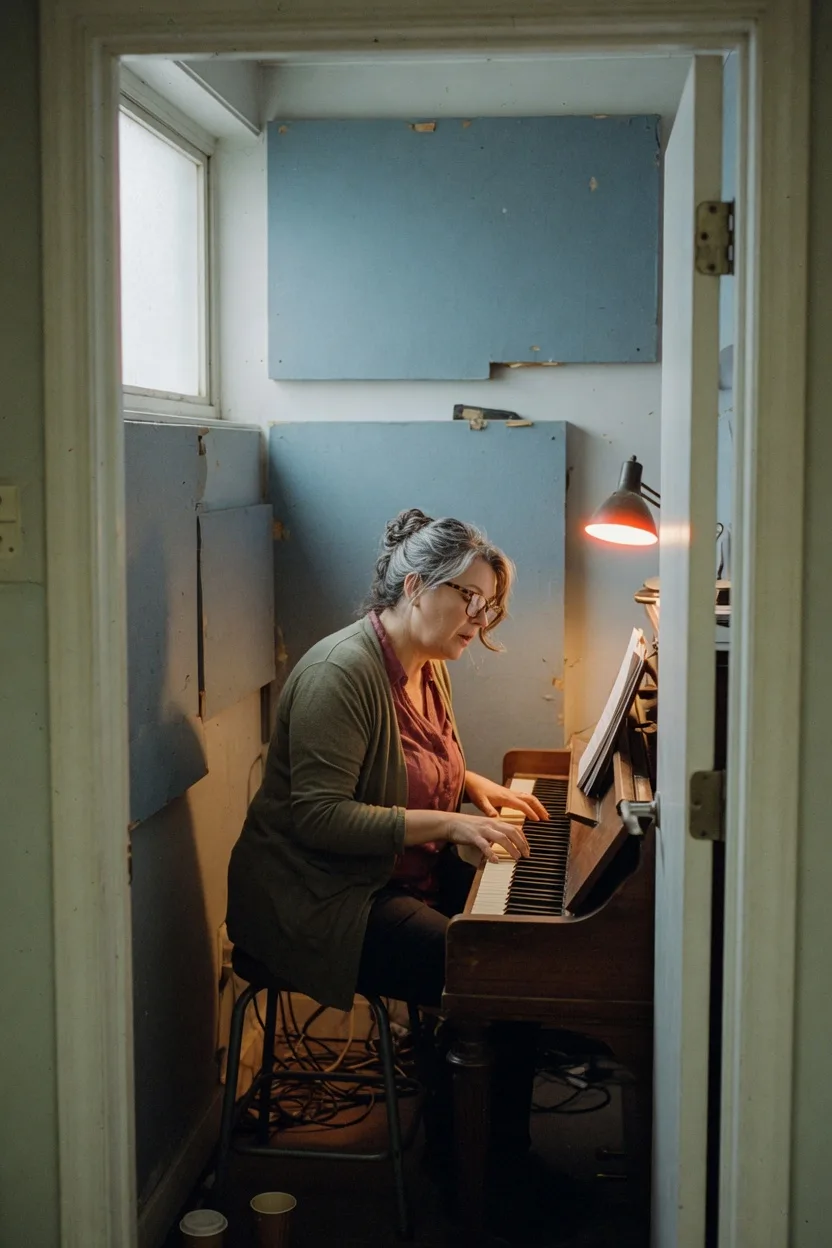
On a quiet Thursday morning in late autumn, a retired teacher walked through our doors at 14 Calder Lane. For forty years, she had taught in the local Wellmouth school system, dedicating her working life to students while living in modest apartments where an acoustic piano was impractical. Throughout those four decades, she practiced on a small keyboard with light plastic keys, always promising herself that once she retired, she would find a proper acoustic upright piano with weighted wooden keys and natural felt hammers. When she finally stepped into Hazuki Instruments, she told Kenji Arai, who manages our first floor, that she felt both eager and intimidated.
Walking into an instrument shop after forty years of anticipation can be overwhelming for any musician. Many commercial music stores line instruments up in sterile rows under harsh fluorescent lights, expecting customers to perform in front of strangers while salespeople hover nearby. At Hazuki Instruments, our approach has always been different. Founded in 2009 by Mara Ellison, our shop operates under the conviction that choosing an instrument must be a personal fitting rather than a hurried commercial transaction. Musical instruments are physical companions; their touch, key resistance, and acoustic resonance must align naturally with the hands and ears of the person playing them.
Kenji welcomed the retired teacher with quiet patience and led her upstairs to the first floor, where our upright and digital pianos sit in soft natural daylight. Instead of reciting sales figures or pushing specific models, Kenji asked about the music she loved to play at home. She spoke of quiet evening hymns, classical preludes, and nocturnes she had not performed since her youth. Kenji selected three upright pianos with distinctly different tonal characters: one with bright, crystalline projection; another with a warm, mellow timber; and a third with an exceptionally responsive, balanced keyboard action.
To give her the quiet space she needed, Kenji invited her into one of our three second-floor sound booths. Our sound booths were built in 2017 precisely for moments like this. We scheduled her for a full forty-five-minute session, closed the heavy door, and left her entirely alone. For the first ten minutes, the hallway outside remained completely silent. Then, through the insulated glass, the gentle opening chords of a nocturne began to float down the corridor. She played without hesitation or self-consciousness, testing pedal travel and feeling how each hammer responded to subtle variations in finger weight.
When her forty-five minutes ended, she stepped out into the hallway visibly moved. She had chosen the second upright piano—the instrument with the rounded wood casing and deep, mellow acoustic resonance. She explained that sitting at its keyboard felt like conversing with an old companion who understood her touch immediately. There was no pressure to finalize paperwork on the spot. We noted her chosen piano, offered her time to reflect, and arranged safe delivery to her home the following week.
The fitting did not end when the piano left 14 Calder Lane. Moving an acoustic upright across town inevitably settles its frame and alters string tension, so Kenji scheduled a follow-up home visit to tune the piano once it had adjusted to the temperature and humidity of her living room. Ensuring every instrument receives attentive aftercare is central to our values. Today, she plays every morning by the window of her home. Helping a musician find the one instrument that fits after forty years of patience is the exact reason we open our doors each morning.